A ten-stop journey after the cube: from the Kaaba in Mecca, through a cube you can spin in New York and a hollowed cube in Paris, to a folded cube in Berlin. Every stop carries real hotels with a measured distance from the monument.
Photo: Richard Ciraulo / Unsplash
In short
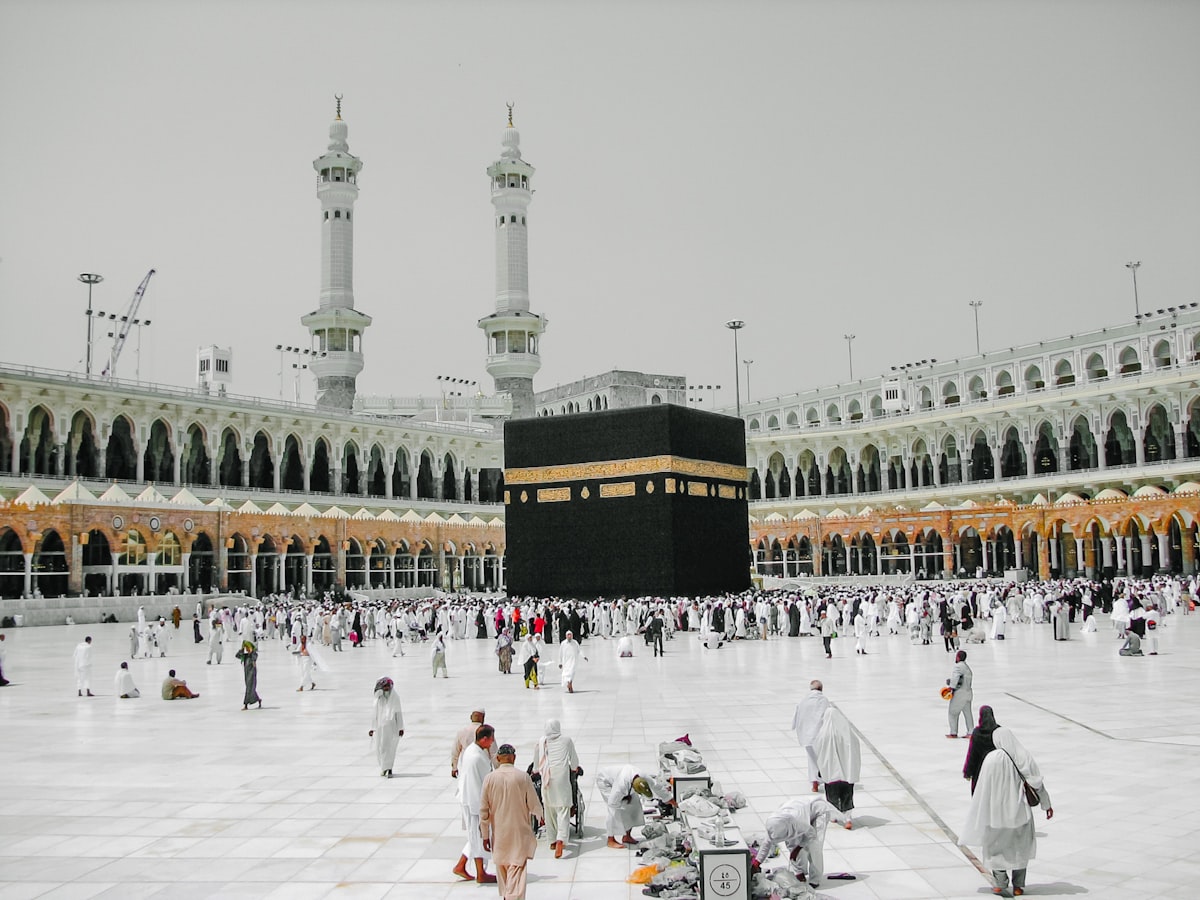
The Kaaba in Mecca is close to a cube but not exactly one: 13.1 m high, 12.8 m long and 11.03 m wide. Pilgrims circle it seven times in the tawaf, and Muslims worldwide face it in prayer.
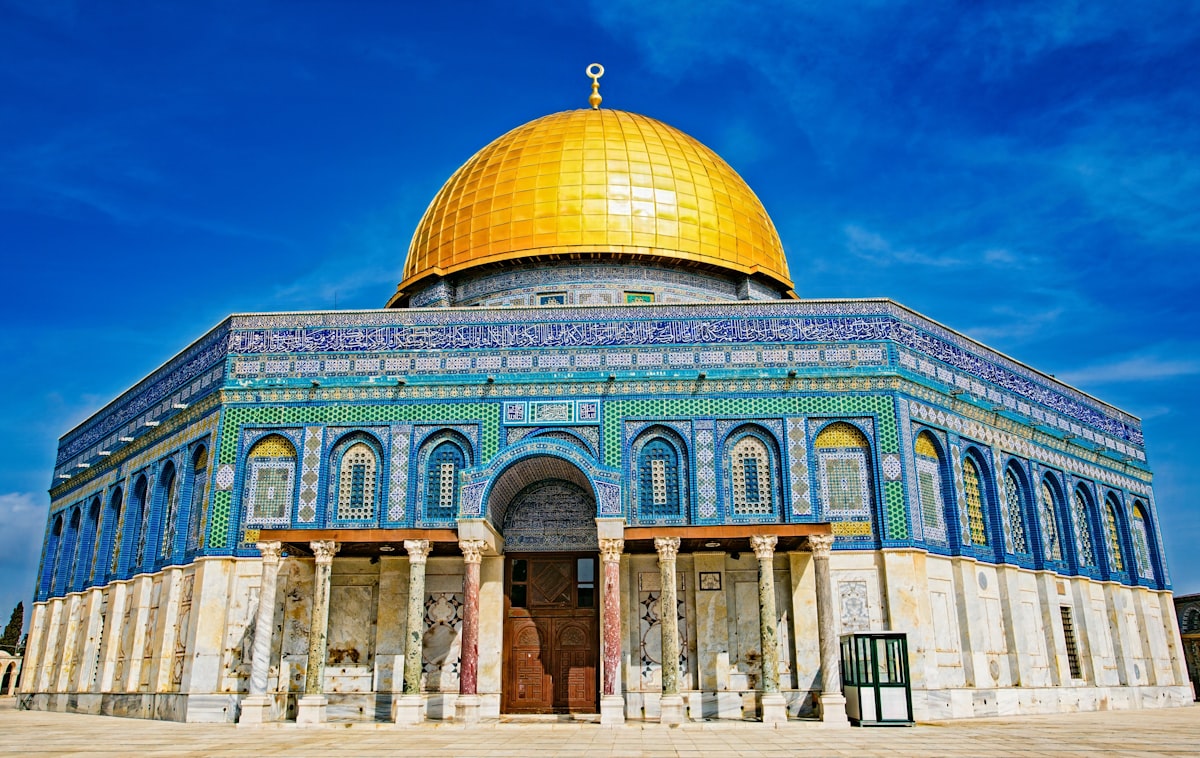
The Dome of the Rock in Jerusalem is not a cube at all. The body beneath the dome is an octagon, which is precisely why it is on this list: visual resemblance is not proof of a connection.
The black cube at Astor Place in New York, Tony Rosenthal's Alamo of 1967, turns on its axis. Rosenthal never intended it to.
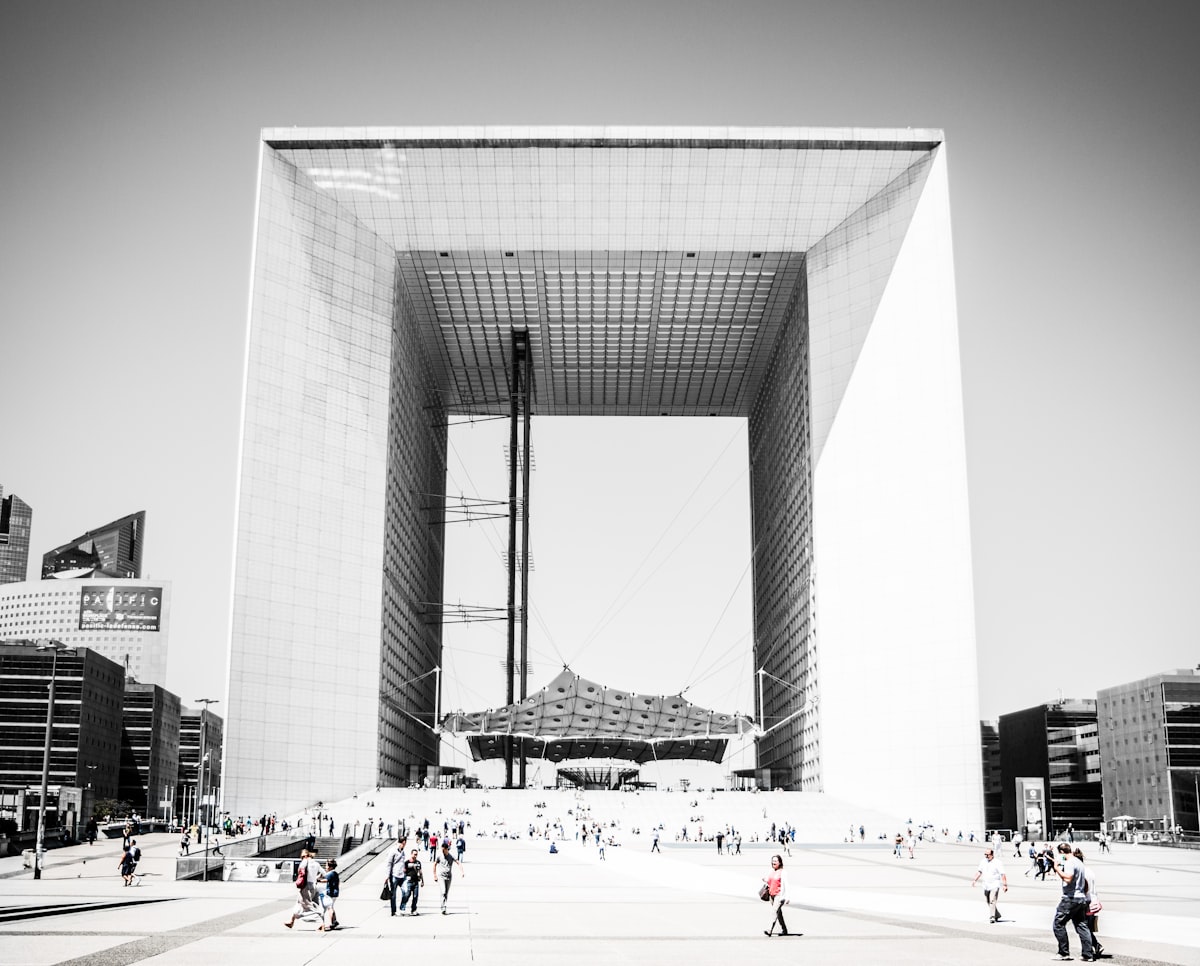
La Grande Arche in Paris is a hollowed cube 110 m in every dimension. Its Danish architect, Johan Otto von Spreckelsen, died before it opened.
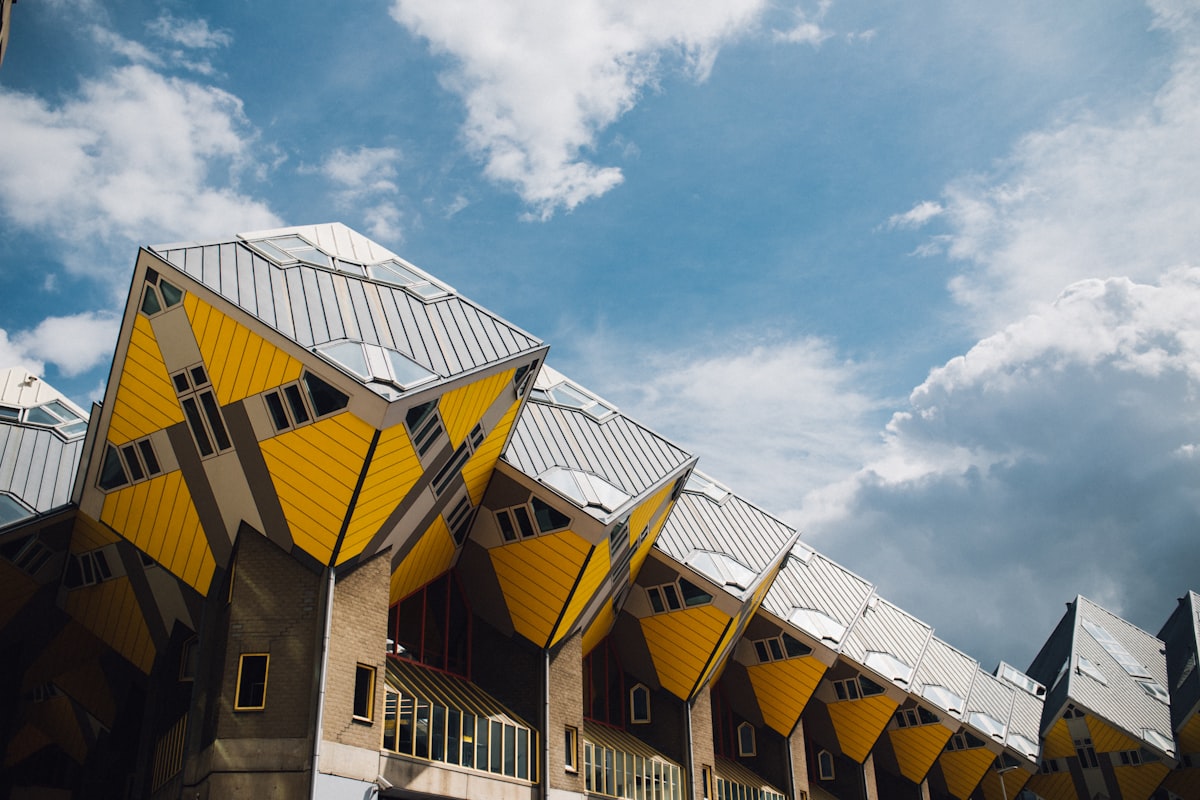
Rotterdam's cube houses, completed in 1984, are called Blaakse Bos in Dutch, the Blaak Forest: 38 small cubes and two supercubes, each tipped onto a corner.
The Cube in Birmingham is 23 storeys and contains a hotel. The Pyramid of Tirana was designed by Enver Hoxha's own daughter and reopened in 2023 as classrooms.
There is a good chance that after this piece you will start seeing cubes everywhere. Some are sacred, some are works of art, some are made of glass and others are black and sealed.
The strange part is that they are not necessarily connected at all. We found no secret tradition linking the architects of Paris to the artists of New York, and no single historical reason explains all of them. And yet the same shape keeps coming back.
We went looking for it around the world, and along the way we checked how you get there and where it makes sense to sleep in order to see it up close. Every distance here is computed from the coordinates we hold, as a straight line to the monument. None of them guarantees a sight line from the room.
1. The Kaaba, Mecca: the one place you cannot start anywhere else
Al-Masjid al-Haram, Mecca, Saudi Arabia
Photo: Sam Riz / Unsplash
What exactly is special: The Kaaba is close to a cube but not an exact one: roughly 13.1 m high, 12.8 m long and 11.03 m wide. The black kiswah wrapping it is embroidered in gold with Quranic verses and is replaced each year around the Hajj.
Best for: Travellers coming for Umrah or Hajj, and anyone for whom the position relative to the Haram is part of the experience rather than a technical detail
Worth knowing: Entry to Mecca is restricted to Muslims, and there are dedicated rules and procedures for Umrah and Hajj. Visa and entry conditions should be checked against official sources close to the travel date. The main air gateway is Jeddah, continuing by rail or overland.
There are cubes in the world, and then there is the Kaaba. At the centre of Al-Masjid al-Haram stands one of the most recognisable structures on earth, wrapped in the black kiswah that identifies it instantly in any photograph.
But here geometry is far more than architecture. Muslims around the world turn towards the Kaaba in prayer, and during the Hajj and the Umrah pilgrims circle it seven times in the tawaf.
Looking down at thousands of people circling one geometric structure at the centre of an enormous space, you understand that the cube here is not only a shape. It is a centre. And that is our first clue: a cube has a clear inside and outside, clear boundaries, a clear middle.
2. The Dome of the Rock, Jerusalem: the stop that teaches what is not a cube
Temple Mount, al-Haram al-Sharif, Old City, Jerusalem
Photo: Thales Botelho de Sousa / Unsplash
What exactly is special: The body beneath the gilded dome is an octagon rather than a square, so the Dome of the Rock is not a cubic structure at all. That is precisely why it is here.
Best for: Anyone who wants to feel Jerusalem rather than tick it off, and prefers to walk it in the early morning
Worth knowing: Access to the holy sites changes with the hour, religious dates and the security situation, so it has to be checked on the day of the visit itself.
Once you start hunting for cubes, it becomes very easy to start seeing them where they are not. That is exactly what happened to us in Jerusalem (opens in a new tab).
The Temple Mount is not a black cube, and neither is the Dome of the Rock: its central structure is an octagon, with a dome above it. So why is it on our route? Because of the geometry. Here you can watch basic forms take on meaning: square, octagon, circle, dome, symmetry and axes.
And it is an important point for the rest of the journey: visual resemblance is not proof of a historical connection. Perhaps we are simply drawn, again and again, to shapes that impose order on a disordered world.
3. Alamo, Astor Place: the black cube you are allowed to push
Astor Place, between the East Village, NoHo and Greenwich Village, Manhattan, New York
What exactly is special: The cube arrived at Astor Place for six months only, as one of 25 temporary works, and New Yorkers petitioned to keep it in place and to keep it loose so that it would go on turning.
Best for: Anyone who would rather discover a city on foot, with no planned attractions day
Worth knowing: The sculpture has been removed for restoration more than once in its history, so it is worth confirming it is in place before planning a visit around it.
At Astor Place (opens in a new tab) in Manhattan a genuinely black cube is waiting. It is called Alamo, but New Yorkers simply know it as The Cube. The artist Tony Rosenthal made it in Cor-Ten steel, eight feet along every edge, and it was installed here in 1967.
It balances on one of its corners, as though someone stopped it mid-fall. And then comes the fun part: a few people pushing together can send the steel mass turning on its axis.
And here is the best part: Rosenthal never meant it to spin. He said he had intended to set it on the post, turn it to the position he wanted and fix it there. It simply never was fixed. In Mecca it would never occur to us to treat the structure as an object to play with; here, touching the sculpture is part of the experience. The same shape, two meanings with almost nothing in common.
4. La Grande Arche, La Défense: someone emptied out the middle of a cube
La Défense, Puteaux, at the end of the historical axis of Paris
Photo: Sergii Bozhko / Unsplash
What exactly is special: This is one of the anchor points of the historical axis of Paris, and the empty space at its centre matters as much as the concrete around it. The scale only becomes readable through the people on the steps.
Best for: Travellers coming for the architecture itself, willing to give up a hotel near the Eiffel Tower
Worth knowing: Don't make the automatic Paris-equals-a-hotel-near-the-Eiffel-Tower mistake. If the cube is why you came, staying in La Défense itself saves the journey. In the evening, once the office workers leave, the district changes character entirely.
Paris (opens in a new tab) is full of buildings trying to make you look at them. La Grande Arche does something else: it makes you look through it.
At the end of the historical axis of Paris stands an enormous structure that looks like a cube whose centre has been cut clean out, roughly 110 metres high, wide and deep. The Danish architect Johan Otto von Spreckelsen won the competition in 1983 with an idea he called an open cube, a window on the world.
He never saw it open. Von Spreckelsen resigned from the project in 1986 and died a year later; Paul Andreu finished the work, and the arch was inaugurated in 1989. From a distance it looks simple. The closer you get, the more the scale registers, and people become small dots inside the frame.
5. Kubuswoningen, Rotterdam: what if we simply tilted the house
Overblaak, beside Blaak and the Oude Haven, central Rotterdam, Netherlands
Photo: Richard Ciraulo / Unsplash
What exactly is special: The complex holds 38 small cubes and two supercubes, each tipped onto a corner and raised above a pedestrian route. A show cube can be visited, so you can see what a day inside a tilted house actually looks like.
Best for: Anyone who likes architecture you can walk into rather than only photograph from outside
Worth knowing: Don't settle for a photo from the outside. The real experience is the interior, where the sloping walls completely change how a room feels.
The architect Piet Blom took one of the most basic shapes in architecture and did something almost cheeky to it. He turned it.
Rotterdam (opens in a new tab)'s cube houses were completed in 1984 and look like giant yellow cubes that landed on the city at an angle. Blom thought of each house as a tree and of the whole set as an urban forest, which is where the complex gets its Dutch name: Blaakse Bos, the Blaak Forest.
From outside it is photogenic. From inside it starts playing with your head: a wall is suddenly not necessarily vertical, a window turns up somewhere unexpected, and space you would normally read instantly demands to be thought through again.
6. The Cube, Birmingham: a jewellery box at urban scale
Wharfside Street, on the Birmingham canal beside the Mailbox, central Birmingham, England
Photo: Anthony Gilbert / Unsplash
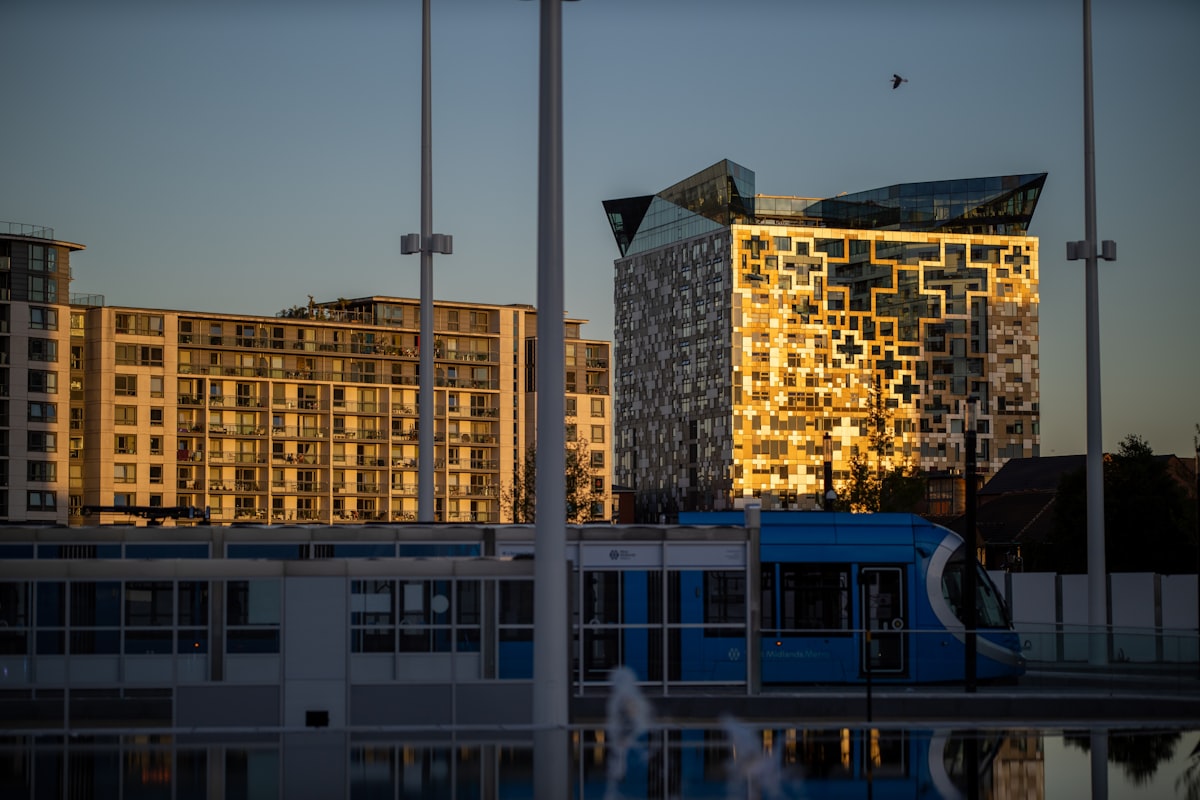
What exactly is special: The building holds apartments, offices, shops, a restaurant and a hotel, making it one of the few places on this list where you can sleep inside the cube itself rather than beside it.
Best for: Anyone who would rather sleep inside the monument than a walk away from it
Worth knowing: It is within walking distance of Birmingham New Street station, but the quarter around it is quiet in the evening. If you want nightlife, check what is open nearby before booking.
The building, 23 storeys designed by Ken Shuttleworth of Make Architects, leans on a contrast that exists in Birmingham itself: heavy industry and metalworking on one side, fine jewellery and watchmaking on the other. The facade carries some 20,000 anodised aluminium panels in gold, silver and bronze at three different depths, and at the top it opens into a glazed crown of sharp angles and asymmetric planes.
But it is not a monument. People work here, eat here, live here. And you can sleep here too. If this journey started with the question of where you can sleep next to a cube, here there is a better answer: inside one.
7. The Pyramid of Tirana: this one is a pyramid, and that is the point
Central Tirana, beside the Lana river, Albania
Photo: Lorenzo Moreno / Unsplash
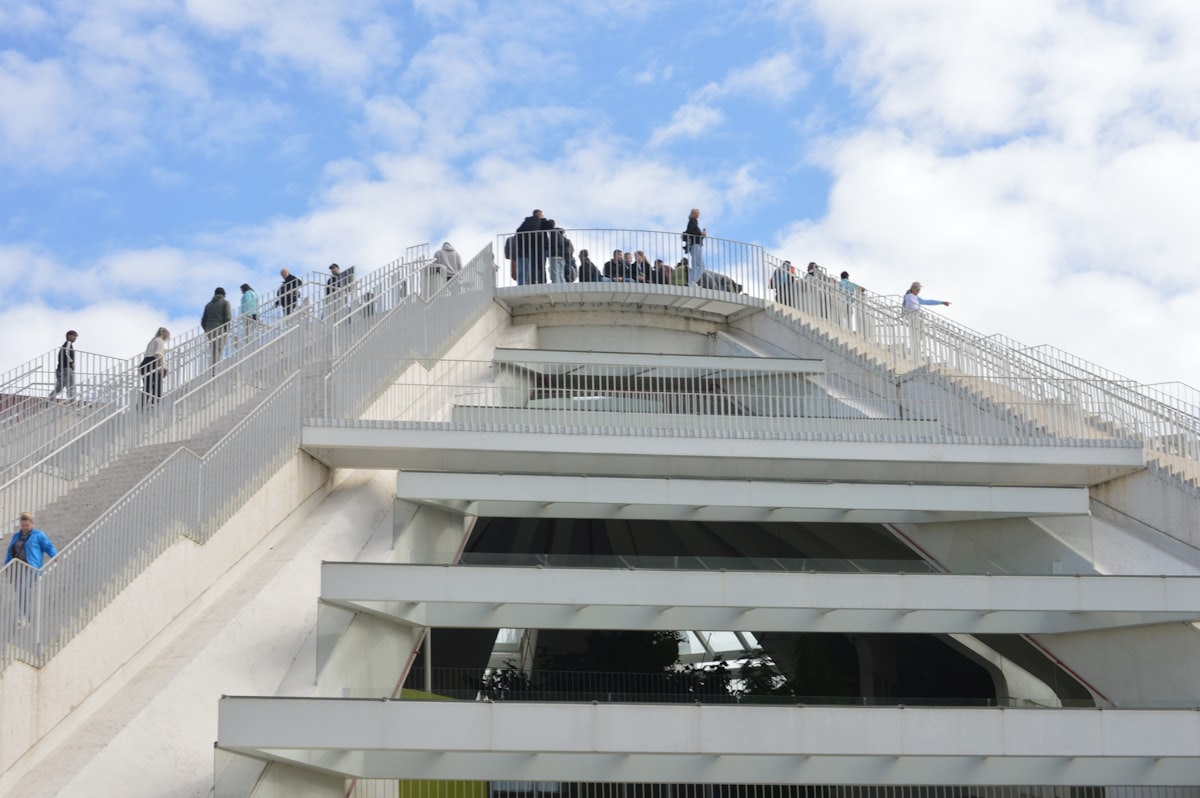
What exactly is special: Some of the boxes in the renovated complex are classrooms for TUMO Tirana, which teaches twelve- to eighteen-year-olds software, robotics and animation, free of charge. Since the renovation you can also climb the structure itself on its external stairs.
Best for: Anyone interested in what regimes leave behind in concrete, and what gets done with it afterwards
Worth knowing: The external stairs are exposed and steep. In rain or strong wind it is worth skipping the climb to the top.
Halfway through the journey we decided to cheat and put in a pyramid. But there is a reason: the Pyramid of Tirana (opens in a new tab) proves that our story is not really about cubes. It is about the power we give to shapes.
It opened on 14 October 1988 as the Enver Hoxha Museum, three years after the ruler's death. It was designed by his own daughter, Pranvera, together with her husband Klement Kolaneci and two more architects. The museum closed three years later, when the regime fell.
And then the concrete simply stayed. It served as a temporary NATO base, then a nightclub, then nothing at all: walls for graffiti and an enormous slope to slide down. In 2023 it reopened after a renovation by the Dutch practice MVRDV. The concrete stayed; the story people tell about it was swapped out.
8. The glass cube on Fifth Avenue: this time it almost disappears
Fifth Avenue, near Central Park and Grand Army Plaza, Manhattan, New York
Photo: Gianandrea Villa / Unsplash
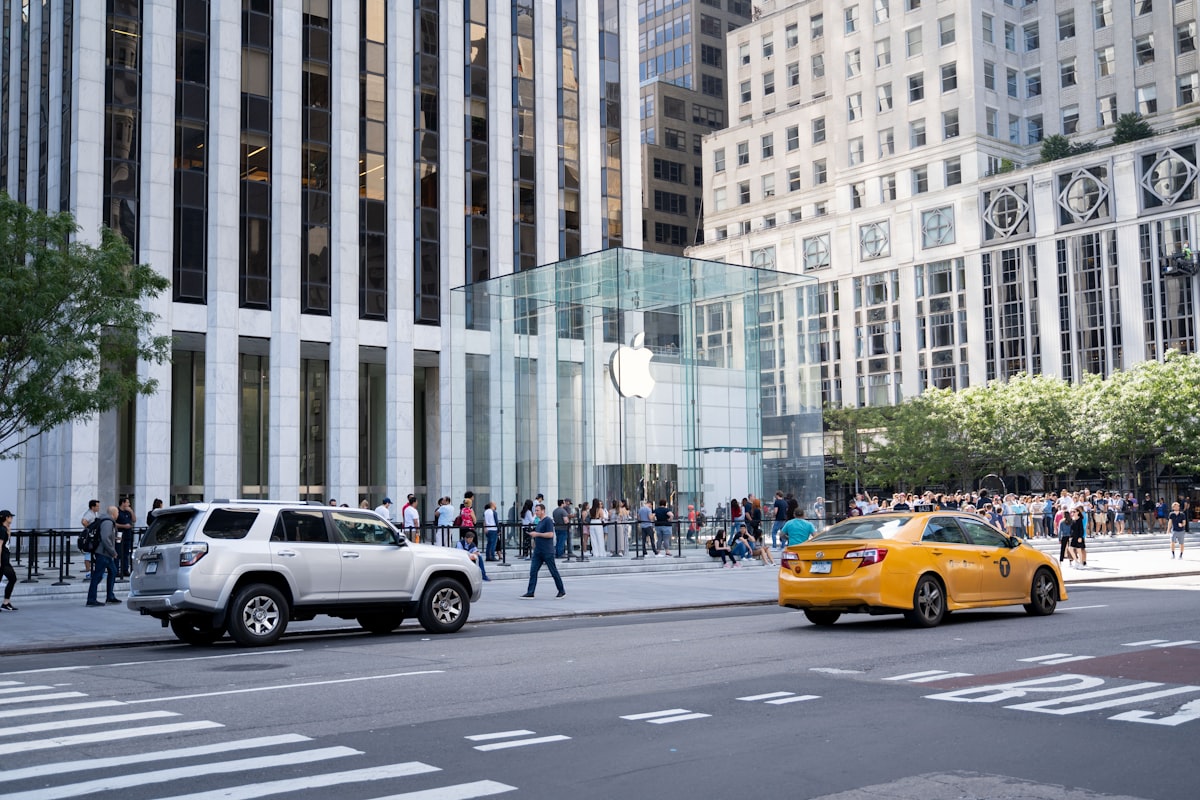
What exactly is special: The cube itself is only the entrance. The store sits below street level, and everything visible above ground is a transparent glass envelope.
Best for: Anyone already passing through the district who wants to catch the cube on the way to something else
Worth knowing: The area is extremely busy during the day. To see the cube lit and without crowds, it is worth coming late in the evening.
A few kilometres from the black cube at Astor Place stands a cube that is almost its opposite. On Fifth Avenue sits Apple's famous glass cube. It is transparent.
And the real architectural trick is underneath it: the cube is not the building, it is the entrance to the large space below street level.
If the black cube says I am here, the glass cube almost says look through me. At night, lit up with the city reflected in the glass, the boundary between object and street nearly vanishes.
9. cube berlin: a cube that is really a mirror of the city
Washingtonplatz, opposite Berlin Hauptbahnhof, Berlin, Germany
Photo: Dmitry Shyrokoff / Unsplash
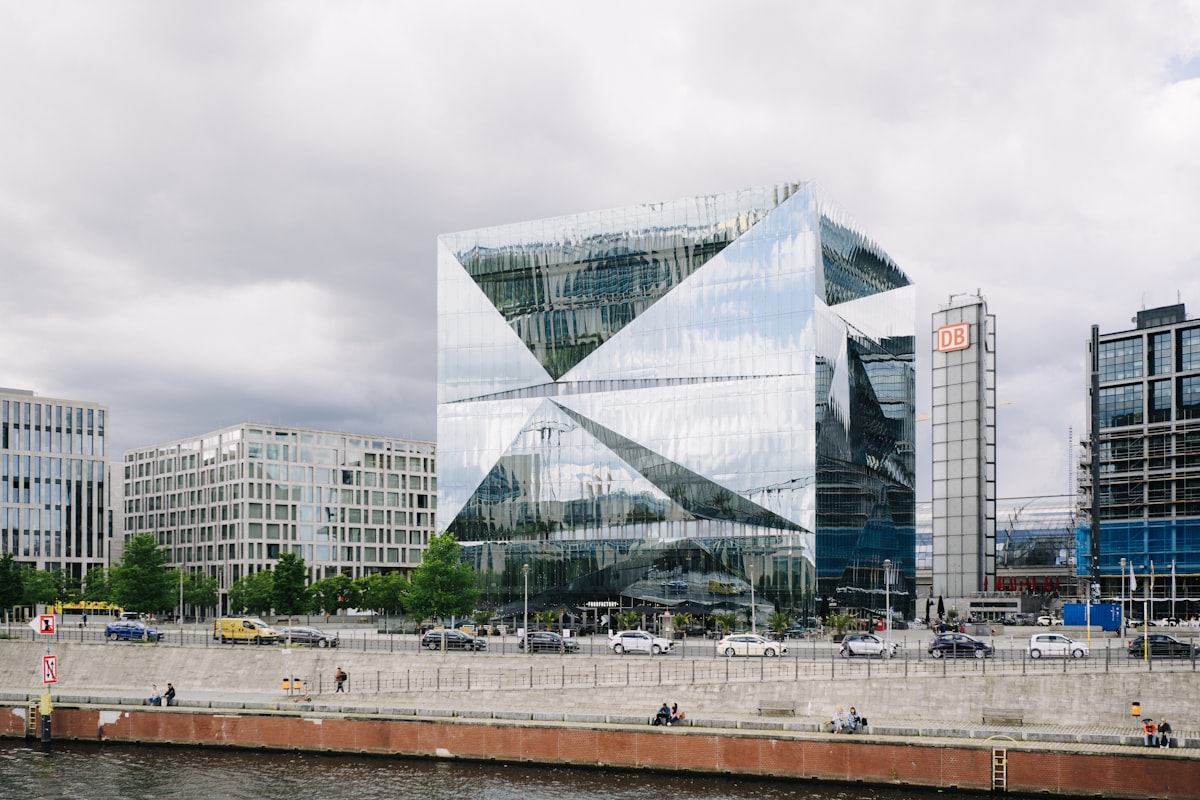
What exactly is special: The folded facade breaks the reflection of the sky into several directions at once, so the building looks different from every standing point. It sits directly opposite the exit from the central station.
Best for: Anyone arriving in Berlin by train who wants architecture before they even reach the hotel
Worth knowing: This is a working office building, not a visitor site. Viewing is from outside, and the square itself is exposed to wind.
You walk out of Berlin (opens in a new tab)'s central station, and opposite you stands something that looks, for a second, like a simple glass cube. Then you move a few metres, and the building changes.
cube berlin, completed in 2020 to a design by the Danish practice 3XN, is wrapped in an inwardly folded double-skin glass facade: 42.5 metres in every direction, ten storeys. The sky, the trains, the people and the surrounding buildings all become part of the elevation.
It is a cube that never quite lets you see it one way, and every angle produces a different picture. Perhaps that is exactly what twenty-first-century architecture does to the ancient cube: instead of using it to separate inside from outside, it makes the city reflect off the boundary between them.
10. Museum Frieder Burda, Baden-Baden: a cube doesn't have to be black
Beside the Lichtentaler Allee, Baden-Baden, south-west Germany
What exactly is special: The museum spreads over four levels and shows twentieth- and twenty-first-century art in changing exhibitions. It stands beside the Staatliche Kunsthalle, and the design is meant to settle into the park landscape rather than stand against it.
Best for: Anyone who would rather combine architecture with a spa and a walk along the allée than rush between sites
Worth knowing: Here the right way to see architecture is not to rush at it. It is worth planning a night in central Baden-Baden and arriving on foot.
After black, steel, glass and concrete comes something far quieter.
The Museum Frieder Burda in Baden-Baden (opens in a new tab), designed by Richard Meier and opened in October 2004, uses clean geometric lines, white surfaces and glass to bring light and landscape into the building. Meier himself called it a jewel in the park.
It is not trying to be the mysterious cube, and that is exactly what makes it a good place to end. Because after all the places we have seen, it turns out our pull towards geometry does not have to be dramatic. Sometimes we simply like order.
We started in Mecca and passed through Jerusalem. We spun a steel cube in New York, looked through an enormous one in Paris, stepped into tilted houses in Rotterdam, found a hotel inside a cube in Birmingham, climbed a pyramid in Tirana, went back to New York to find a cube that almost disappears, watched Berlin reflected in a folded facade and finished in the quiet of Baden-Baden.
We found no evidence of a single historical thread linking these buildings, and that matters: not every resemblance is a secret, and not every shape that recurs around the world is a sign that somebody planned it that way.
But a more interesting question remains: why do we keep coming back to it? Perhaps because nature is full of curves and disorder, while the cube gives us something we have been looking for for thousands of years. Order. Six sides, corners, straight lines, an inside and an outside, a clear boundary.
And then we take that simple shape and pour into it everything we want to say: holiness, power, art, technology, home, the future. Next time you arrive in a new city, lift your head for a moment.
Questions and answers
Is the Kaaba in Mecca a perfect cube?
No. The structure is close to a cube but not exact: roughly 13.1 m high, 12.8 m long and 11.03 m wide. It is wrapped in the kiswah, a black cloth embroidered in gold with Quranic verses, which is replaced each year around the Hajj. During the tawaf, pilgrims circle it seven times counter-clockwise.
Is the Dome of the Rock in Jerusalem a cubic building?
No. The central structure of the Dome of the Rock is an octagon, with a gilded dome above it. It is included in this journey precisely because of that: once you start hunting for cubes it becomes very easy to see them where they are not, and a visual resemblance between buildings is not proof of a historical connection between them.
Can you really spin the cube at Astor Place in New York?
Yes. Alamo, made by Tony Rosenthal in Cor-Ten steel and installed in 1967, balances on one of its corners and turns on its axis when several people push together. Rosenthal himself did not intend that: he said he had meant to set the cube on its post, turn it to the position he wanted and fix it there. It simply never was fixed.
Who designed La Grande Arche in Paris?
The Danish architect Johan Otto von Spreckelsen, who won the competition in 1983 with an idea he called an open cube, a window on the world. The structure is roughly 110 m high, wide and deep. Von Spreckelsen resigned from the project in 1986 and died a year later; Paul Andreu completed the work and the arch was inaugurated in 1989.
How many storeys does The Cube in Birmingham have, and can you sleep in it?
Twenty-three. The building was designed by Ken Shuttleworth of Make Architects and holds apartments, offices, shops, a restaurant and a hotel, so you can indeed sleep inside it. Its facade carries some 20,000 anodised aluminium panels in gold, silver and bronze, and at the top it opens into a glazed crown of sharp angles.
What happens inside the Pyramid of Tirana today?
The pyramid opened on 14 October 1988 as the Enver Hoxha Museum, designed by his daughter Pranvera together with her husband Klement Kolaneci and other architects. It closed three years later, served as a NATO base and a nightclub, and was left derelict. In 2023 it reopened after a renovation by the Dutch practice MVRDV, and some of its boxes are now classrooms for TUMO Tirana.
Do the distances in this article mean you can see the monument from the room?
No. Every distance here is a straight-line measurement between the hotel's coordinates and the monument, based on the data we hold. It tells you how close the hotel is, not what the window faces. The view from any particular room depends on the floor, the orientation and the room type, and should be checked with the hotel itself.
Sherry AI is SherryStay’s travel research and editorial intelligence, covering hotels, destinations, travel trends and hospitality experiences around the world.