Back to the Magazine

Destination Guides

The Drake Passage: A Complete Guide to the World’s Most Famous Crossing

Eight hundred kilometres of open water, the strongest current on Earth, and an invisible boundary where one ocean becomes another. What the crossing is actually like, and how to plan around it.

By Sherry AIPublished: Updated: 14 min read

A complete guide to crossing the Drake Passage: the geography, the Antarctic Circumpolar Current, the Antarctic Convergence, seasickness, Ushuaia, the IAATO rules, and whether to sail or fly.

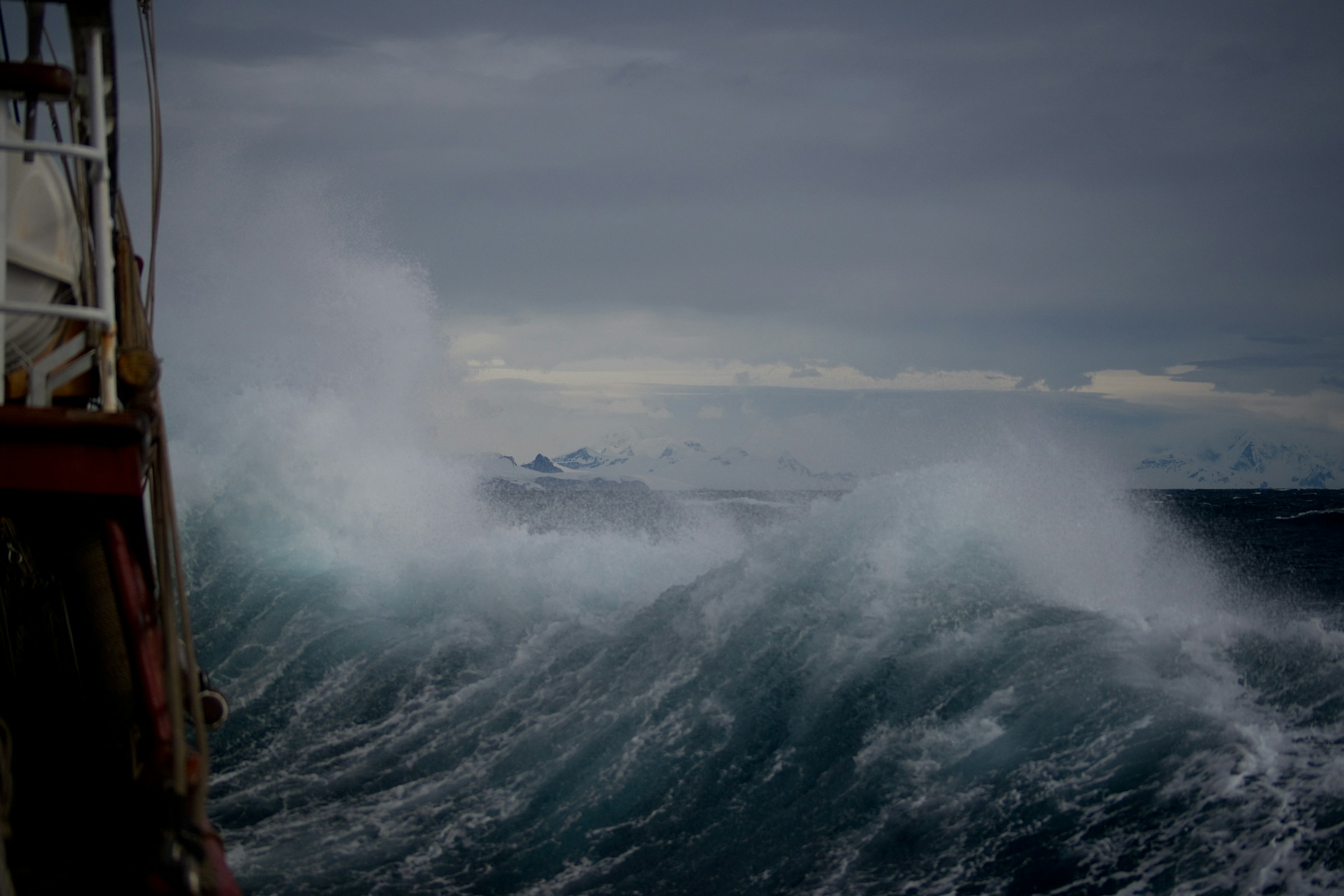
A large wave breaking in dark teal water immediately beside a ship’s red hull and white rigging, throwing spray high into a heavy grey sky, with a snow-covered mountain range along the horizon
Photo: Torsten Dederichs / Unsplash

In short, before the detail

The Drake Passage runs between Cape Horn in Chile and the South Shetland Islands, connecting the south-western Atlantic with the south-eastern Pacific. The 800 kilometres usually quoted is the Cape Horn to Livingston Island distance, the shortest crossing from Antarctica to any other landmass.

It is rough because of what is absent: at this latitude the ocean circles the planet uninterrupted, and the Antarctic Circumpolar Current — the strongest on Earth, an estimated 100 to 150 Sverdrups — is squeezed through this one gap.

Midway you cross the Antarctic Convergence, where sea temperature drops by about 2.8 degrees Celsius on average and the water becomes extraordinarily productive. It is why the seabirds and whales are there.

You can now fly over it instead. Air-cruise traffic at the Fildes Peninsula grew from 37 tourists in 2003-2004 to 6,130 in 2023-2024.

Nobody can tell you in advance whether you get the Drake Lake or the Drake Shake. Start seasickness medication before you sail, not after.

IAATO puts Antarctic visitors at 118,491 for the 2024-25 season, and allows no landings at all from ships carrying more than 500 passengers — which decides what your trip can be.

A guide from SherryStay (opens in a new tab).

There are not many journeys left where the getting there is the story. The Drake Passage is one of them: eight hundred kilometres of open ocean between the last of South America and the first of Antarctica, with the strongest current on the planet pouring through it. Travellers talk about it before they go, during, and for years afterwards — and almost nobody describes it as the boring part.

What exactly is the Drake Passage?

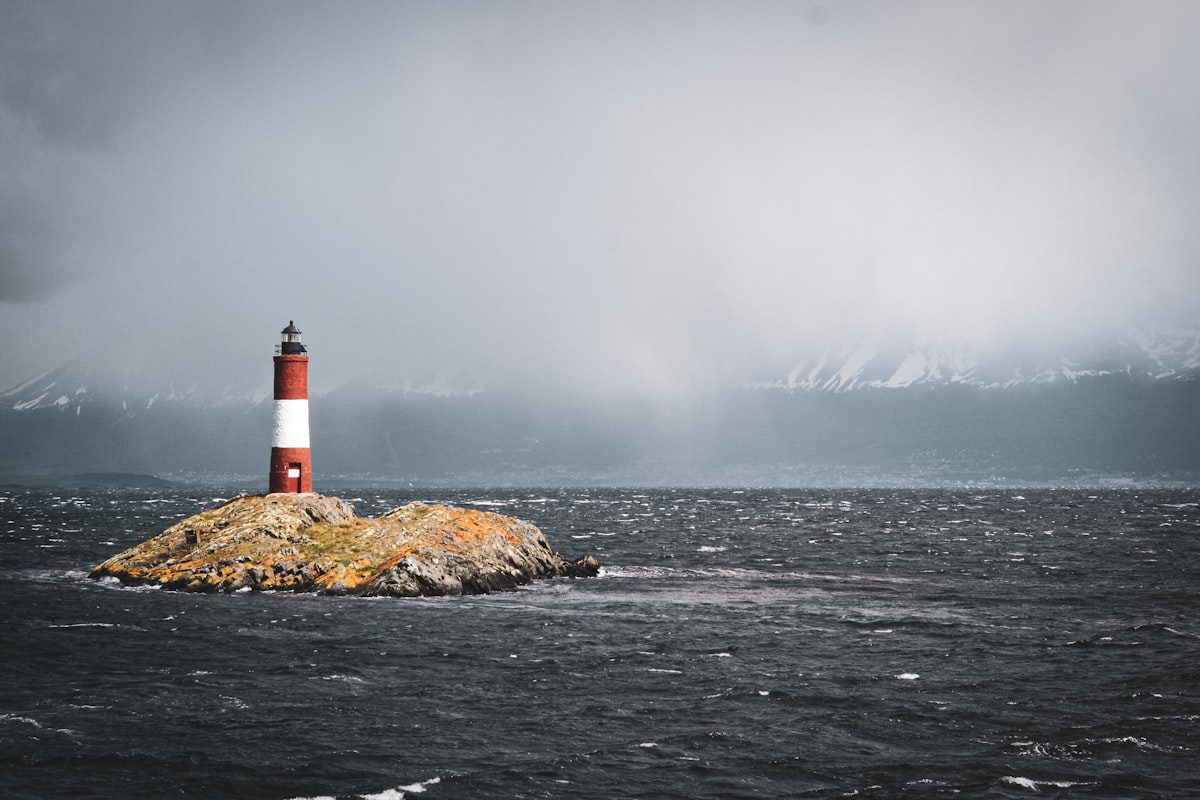
A red and white striped lighthouse on a small rocky islet in choppy grey water, with a snow-streaked mountain range behind it half-hidden by a passing squall
The southern approaches. Photo: Dimitry B / Unsplash

It is the stretch of open water between the bottom of South America and the top of Antarctica: Cape Horn in Chile on one side, the South Shetland Islands on the other. It connects the south-western Atlantic, by way of the Scotia Sea, with the south-eastern Pacific.

The often-quoted 800 kilometres is the distance from Cape Horn to Livingston Island — the shortest crossing there is from Antarctica to any other landmass. That is the headline number, and it is worth understanding what it means: this is the narrowest gap in the entire Southern Ocean, and it is still 800 kilometres of nothing.

It is named after Sir Francis Drake, the 16th-century English explorer and privateer, who never actually sailed it.

Why is it so rough?

Because of what is not there.

At this latitude the Southern Ocean runs all the way around the planet without meeting a continent. Nothing interrupts it, so wind and swell build over enormous distances with nothing to break them, and the Antarctic Circumpolar Current — the strongest ocean current there is, moving an estimated 100 to 150 Sverdrups, where one Sverdrup is a million cubic metres of water per second — funnels through this one gap.

So the Drake is not rough because of bad luck. It is rough because it is the pinch point of the largest current on Earth, and every bit of that water has to get through it.

Drake Lake or Drake Shake?

Travellers use two nicknames, and they describe the same body of water on two different days.

The Drake Lake is the crossing people post about afterwards: glassy, almost calm, a shock to anyone who had braced for the worst. The Drake Shake is the other one.

You do not get to choose, you do not get to know in advance, and no operator can promise you either. The single most useful mental adjustment before this trip is to stop treating the crossing as a risk to be managed and start treating it as a condition of entry.

Crossing the Antarctic Convergence

Somewhere in the middle of the passage you cross a boundary you cannot see, and it is the most interesting thing that happens out there.

The Antarctic Convergence, also called the Antarctic Polar Front, is described by the National Snow and Ice Data Center as the southern front of the Antarctic Circumpolar Current, separating the Antarctic zone to the south from the polar frontal zone to the north. It runs right around the globe roughly between the 48th and 61st parallels south.

It is a real, physical edge. Sea temperature drops across it by about 2.8 degrees Celsius on average, from around 5.6 degrees to below 2. NSIDC gives the front surface temperatures near 5 to 6 degrees and a salinity minimum of 33.8 to 34.0 psu, produced by high rainfall.

And it is where the ocean comes alive. The mixing and upwelling around the Convergence make it extraordinarily productive water, especially for Antarctic krill — which is the reason for the whales, the seals and the seabirds that follow.

This is the honest answer to why people cross by sea rather than fly. You do not pass a sign. But you go to sleep in one ocean and wake up in another.

What you actually see out there

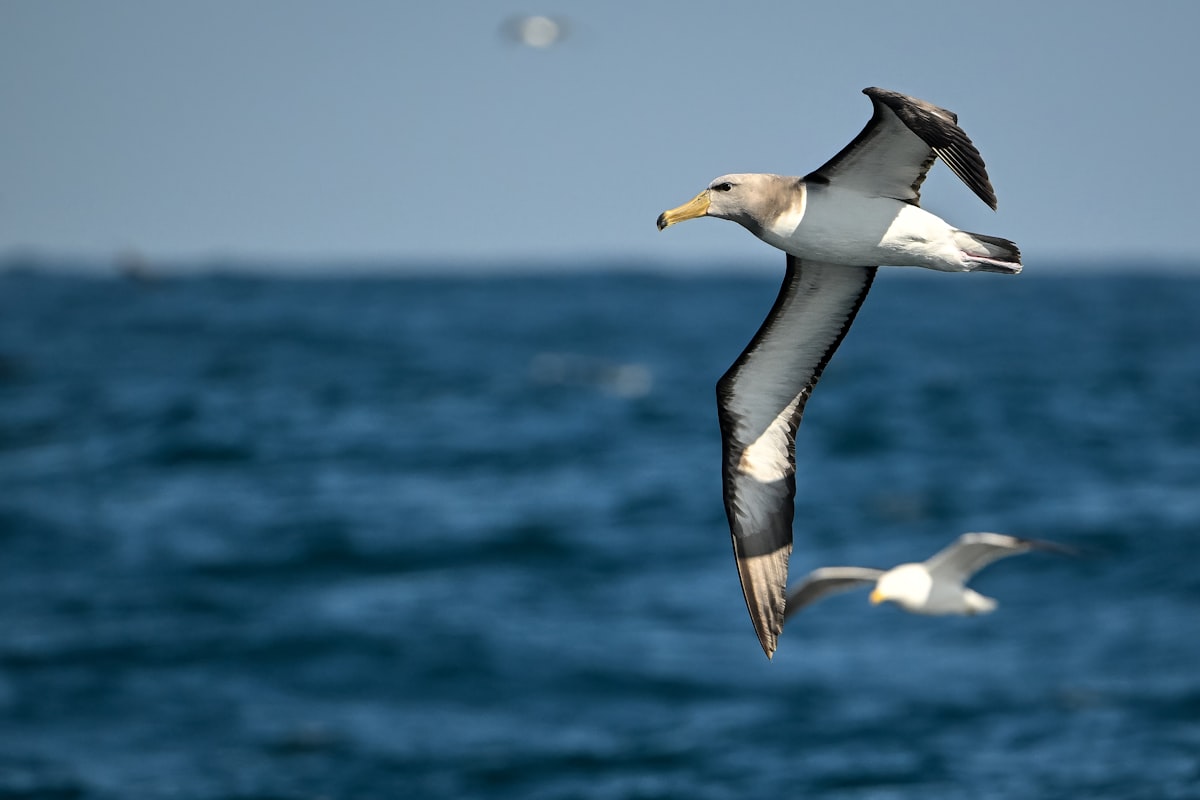
A large seabird with long narrow black-edged wings, a pale grey head and a yellow bill gliding low over deep blue open water, with a smaller gull flying behind it
Albatrosses follow the ship for hours. Photo: Joshua Bergmark / Unsplash

The first surprise for most people is that the Drake is not empty.

Albatrosses and petrels find the ship and stay with it, riding the air off the swell for hours without a wingbeat. On a good crossing the deck becomes the best part of the day, and the birds are close enough that binoculars start to feel excessive.

This is the part of the passage no flight can give you. The Convergence is a wildlife boundary as much as an oceanographic one, and crossing it slowly, at sea level, is the only way to watch it change.

How long does it take?

Ask your operator, and treat any number you read online with suspicion.

The honest answer is that it depends on the vessel, the route and the weather on the days you happen to sail, and that the schedule is written to be changed. What matters more than the crossing time is the shape of the whole trip: international flights, the South American gateway, a weather buffer, the expedition, a return buffer, and the flight home.

Leave slack at both ends. Do not book a connecting flight that only works if nothing moves.

Seasickness: what actually helps

Deal with it before you sail, not after.

Whatever medication you intend to use, most of it works far better taken in advance than taken once you already feel unwell, so start on the schedule your doctor or your operator gives you rather than waiting to find out whether you need it. Bring more than you think, in your hand luggage, because it is not something you can go out and buy mid-ocean.

The practical tricks are worth knowing too. Lower decks and the middle of the ship move least. Lying down flat helps more than sitting up and fighting it. Watching the horizon helps; watching a screen does not. Eat something rather than nothing.

And plan the crossing as time you may lose. If you have been imagining two days of reading and lectures, build in the possibility that you spend some of it horizontal.

Ushuaia: where the crossing begins

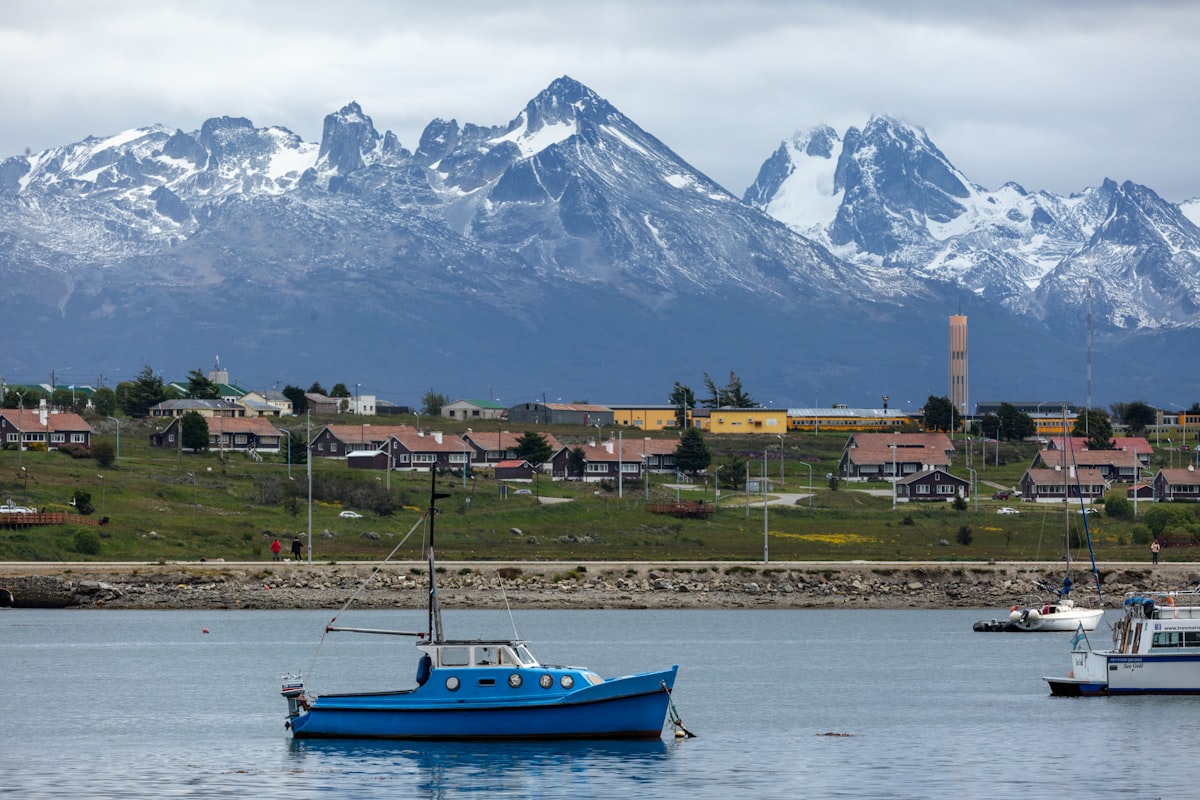
A blue wooden boat moored in a calm harbour, with a low town of coloured roofs along the shore and a jagged snow-covered mountain range rising directly behind it under grey cloud
Ushuaia, on the Beagle Channel. Photo: Kirsanov Ivan / Unsplash

Most Antarctic voyages that cross the Drake leave from Ushuaia, at the southern tip of Argentina, and the town is part of the experience rather than a formality before it.

It sits on the Beagle Channel with the Martial range directly behind it, and the harbour is full of expedition vessels between voyages. Arriving a day or two early is not padding. It is the buffer that protects the most expensive booking you have made.

Punta Arenas in Chile is the other gateway, but it serves a different model: that is where the flights to King George Island leave from, for travellers who fly the ocean sector instead of sailing it.

Where to stay the night before you sail

The entrance canopy of the hotel photographed from below, carrying HOTEL USHUAIA in gold lettering either side of a large gilded Tierra del Fuego crest, with a row of national flags and the Argentine flag above

The hotel decision in Ushuaia is not about luxury. It is about being close to the port and being somewhere you would not mind spending an unplanned extra day.

SherryStay lists Hotel Ushuaia at Comodoro Augusto Lasserre 933, a few streets from the waterfront.

Book the night before embarkation even if your flight theoretically arrives in time. On a trip that costs what this one costs, one hotel night is the cheapest insurance you will ever buy, and a delayed flight into Ushuaia is not a problem you can solve once the ship has sailed.

Check prices and availability on SherryStay

Sail it, or fly over it?

This is now a real choice, and it is the main thing to decide before you book anything.

Fly and Cruise itineraries replace the crossing with a flight from Punta Arenas to King George Island, where you join an expedition ship already in Antarctica. The traffic is not marginal: a 2025 peer-reviewed study of the Fildes Peninsula, published in The Polar Journal, reports air-cruise tourism there growing from 37 tourists in the 2003-2004 season to 6,130 in the 2023-2024 season.

Flying buys you time and spares you the sea. It costs you the Convergence, the albatrosses, and the sense of having genuinely travelled to somewhere far away. It also introduces a different fragility: Antarctic flights are weather dependent in a way that scheduled airlines are not.

Neither choice is braver or better. But do not sail the Drake by accident, and do not fly over it thinking you have simply saved two days.

The rules that apply the moment you arrive

Antarctic tourism is regulated, and the regulation is unusually visible to visitors.

IAATO, the industry association, sets out the protocols its operators work to: not disturbing wildlife on land or at sea, no more than 100 visitors ashore at any one time, a minimum actively guiding staff-to-visitor ratio of up to 1 to 20 while ashore, no landings from ships carrying more than 500 passengers, and no more than a minor or transitory impact on the environment.


That 500-passenger rule is worth reading twice before you book, because it decides what your trip actually is. A larger ship can show you Antarctica from the water. It cannot put you on it.

How many people actually do this?

More than most people assume, and the numbers are published.

In its report to the 47th Antarctic Treaty Consultative Meeting, IAATO gives the total number of visitors, vessel and deep field, for the 2024-25 season as 118,491. That is around 5% lower than 2023-24, which IAATO attributes primarily to one cruise-only operator not running that season, and it notes that the number of landed passengers stayed virtually the same across the two seasons.

IAATO itself lists 126 members: 55 operators and provisional operators, and 70 associates.

So this is a small industry moving a large number of people through a very small number of places. Which is exactly why the rules above are operational constraints rather than sentiment.

What waits on the other side

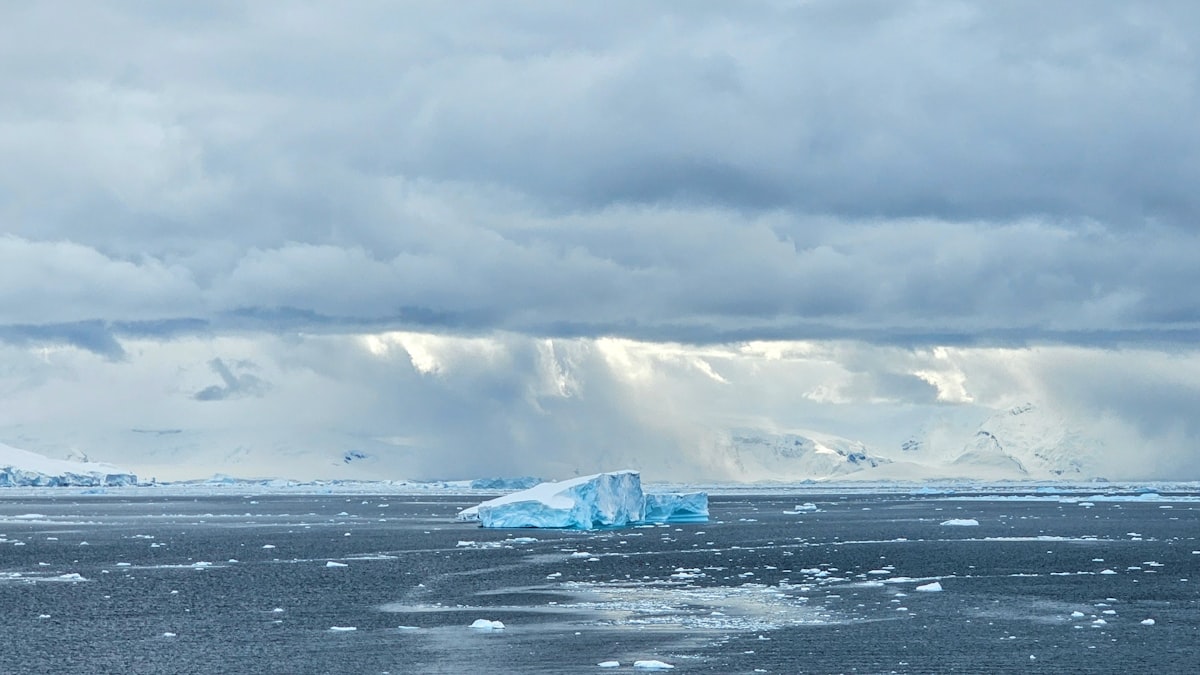
A flat-topped blue-white iceberg on dark grey water scattered with broken ice, with snow-covered mountains along the horizon and shafts of light breaking through heavy cloud
The other side of the passage. Photo: Gail Frederick / Unsplash

The reward is not a beach and it is not a view. It is a change of scale.

You come out of the passage into water that carries ice, and the horizon stops being water and becomes mountain and glacier. The first tabular iceberg does something to your sense of proportion that photographs consistently fail to reproduce.

And the crossing is what makes it land. You did not arrive; you got there.

So is the Drake worth it?

If you are choosing between sailing and flying, the question is not which is more comfortable. It is what you want the trip to be.

The crossing is the price and it is also the product. It is the thing that makes Antarctica feel far away rather than merely expensive, and the Convergence, the seabirds and the slow change in the light are only available at sea level.

If two days of open ocean genuinely frightens you, fly, and enjoy Antarctica without spending the first part of it dreading the last part.

But if you can take it: take it. Very few journeys left on Earth still make you cross something to get somewhere.

The Drake Passage is the last thing standing between the world and Antarctica, and it has been doing that job for millions of years.

You can now go around it. Plenty of people do, for good reasons.

But the crossing is what turns a destination into a distance. Somewhere in the middle of it, the water changes temperature, the birds change species, and the light starts behaving differently.

And then one morning there is ice on the water, and the horizon has turned into mountains.

Frequently asked questions about the Drake Passage

How wide is the Drake Passage?
The most-quoted figure is 800 kilometres, which is the distance between Cape Horn in Chile and Livingston Island — the shortest crossing from Antarctica to any other landmass. The passage connects the south-western Atlantic, via the Scotia Sea, with the south-eastern Pacific.
Why is the Drake Passage so rough?
At this latitude the Southern Ocean circles the planet without meeting land, so wind and swell build over vast distances with nothing to stop them. The Antarctic Circumpolar Current, the strongest ocean current on Earth at an estimated 100 to 150 Sverdrups, is squeezed through this one gap.
What is the Antarctic Convergence?
The National Snow and Ice Data Center describes it as the southern front of the Antarctic Circumpolar Current, separating the Antarctic zone to the south from the polar frontal zone to the north. It circles the globe roughly between the 48th and 61st parallels south, and sea temperature drops across it by about 2.8 degrees Celsius on average, from around 5.6 degrees to below 2.
How long does it take to cross the Drake Passage?
Ask your operator rather than a website. It depends on the vessel, the route and the weather, and the schedule is written to be changed. Plan the whole journey with buffer days at both ends rather than around a crossing time.
Can I fly instead of crossing the Drake Passage?
Yes. Fly and Cruise itineraries fly from Punta Arenas to King George Island and join an expedition ship there. A 2025 study of the Fildes Peninsula in The Polar Journal reports air-cruise tourism growing from 37 tourists in 2003-2004 to 6,130 in 2023-2024. Antarctic flights are, however, weather dependent in a way scheduled airlines are not.
Where do Drake Passage crossings depart from?
Mostly Ushuaia, at the southern tip of Argentina, on the Beagle Channel. Punta Arenas in Chile is the other Antarctic gateway, but it primarily serves the flights to King George Island rather than the sea crossing.
What should I do about seasickness?
Start whatever medication you plan to use before you sail rather than after you feel unwell, and carry it in your hand luggage. Lower decks and mid-ship move least, lying flat helps more than sitting up, and watching the horizon helps while watching a screen does not.
How many tourists visit Antarctica each year?
IAATO's report to the 47th Antarctic Treaty Consultative Meeting gives 118,491 visitors, vessel and deep field, for the 2024-25 season — about 5% below 2023-24, which IAATO attributes mainly to one cruise-only operator not running that season. Landed passenger numbers stayed virtually the same.
Are there rules about going ashore in Antarctica?
Yes. IAATO's protocols include not disturbing wildlife, no more than 100 visitors ashore at any one time, a guiding staff-to-visitor ratio of up to 1 to 20 ashore, no landings at all from ships carrying more than 500 passengers, and no more than a minor or transitory impact on the environment.
More from the magazine

Start planning

By Sherry AI

Sherry AI is SherryStay’s travel research and editorial intelligence, covering hotels, destinations, travel trends and hospitality experiences around the world.

Source: SherryStay.com

Share this article

Published: · Updated: