SherryStay
Back to the Magazine

Hotel Guides

Sleeping Behind Bars: The Prisons You Can Check Into — and Leave Whenever You Want

Not a theme and not prison-inspired decor — the same walls, the same yards, and sometimes the same cells. Seven former prisons where you can book a room today.

By Sherry AIPublished: Updated: 11 min read

Seven former prisons now operating as hotels — what was kept, what changed, and why architecture built to take freedom away works so unexpectedly well as a hotel.

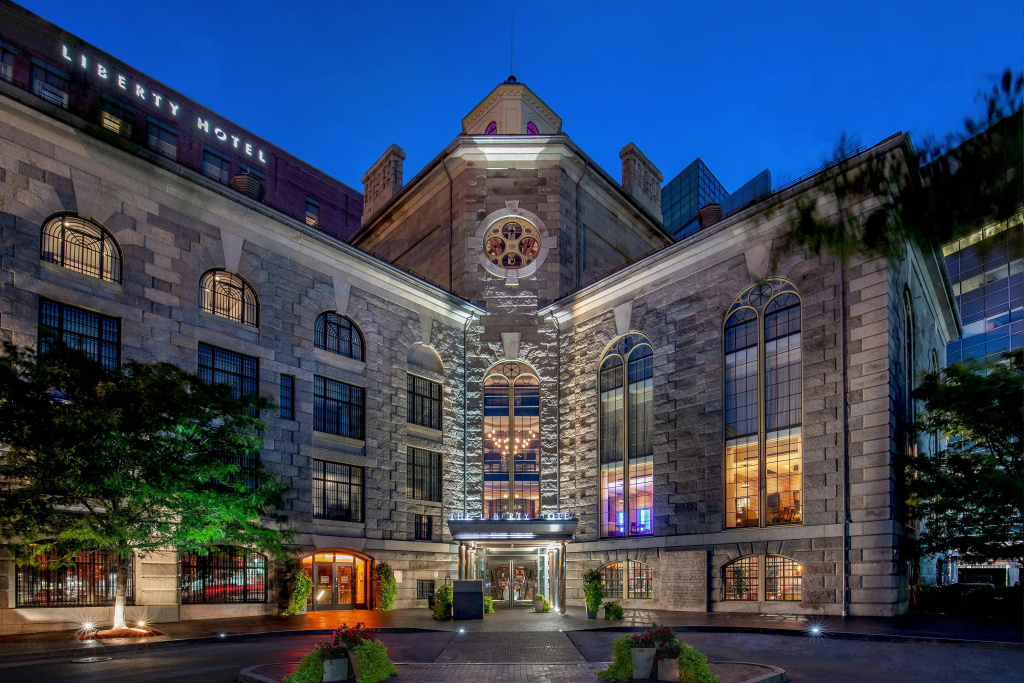
Granite facade of the Liberty Hotel in Boston at dusk, with iron bars still on the lower windows and a round rose window above the entrance
The bars are still there — Liberty, Boston

In short

Seven former prisons operating today as hotels, across four countries.

Not prison-inspired design — the same walls, and sometimes the same cells.

The oldest was built in 1779; the last stopped being a prison only in 2007.

There is an architectural reason: a cell already has something room-shaped about it.

And there is an uncomfortable question the better hotels do not dodge.

There are hotels where you are handed a key at the door. And there are hotels where, not so long ago, the key was held by somebody else entirely.

The doors were heavier. The windows were narrower. The people moving along the corridors were not waiters but guards. And those who went in did not always know when they would come out.

Then something almost unthinkable happened: real prisons, some more than a century old, became hotels.

Not a stage set. Not a new hotel with prison-themed decor. The same walls, the same yards, the same wings — and sometimes the same cells.

Which turns a holiday into a rather interesting question: can a place built to take freedom away be turned into a place that sells freedom, rest and luxury?
The Liberty — Boston

Opened in 1851 as the Charles Street Jail

Granite facade of the Liberty Hotel in Boston at dusk, with tall arched windows, iron bars on the lower windows, a round rose window and a chandelier visible through the central glass
Bars on the lower windows, a chandelier behind them — Liberty, Boston

The name today is almost ironic. Liberty. But the building (opens in a new tab) in Boston (opens in a new tab) opened in 1851 as the Charles Street Jail.

The prison was designed around a tall central space with wings branching off it. The idea was to allow better light and ventilation than was usual in prisons of the period. More than a century later, conditions were a very long way from that original vision.

In the 1970s prisoners protested against the conditions, and eventually a court ruled the facility did not meet constitutional standards. The last inmates left in 1990.

Then an extraordinary transformation began. The stone outer shell was kept. The enormous central space remained. So did the old ironwork, some of the bars, and even original cells inside one of the dining areas.

Today, in a place people wanted to get out of, there is a luxury hotel. Walk into the lobby and look up, and it is hard to ignore that the building still looks like what it was. They simply changed what it means.

Check prices and availability on SherryStay

Malmaison — Oxford

A real Victorian cell, inside the Oxford Castle complex

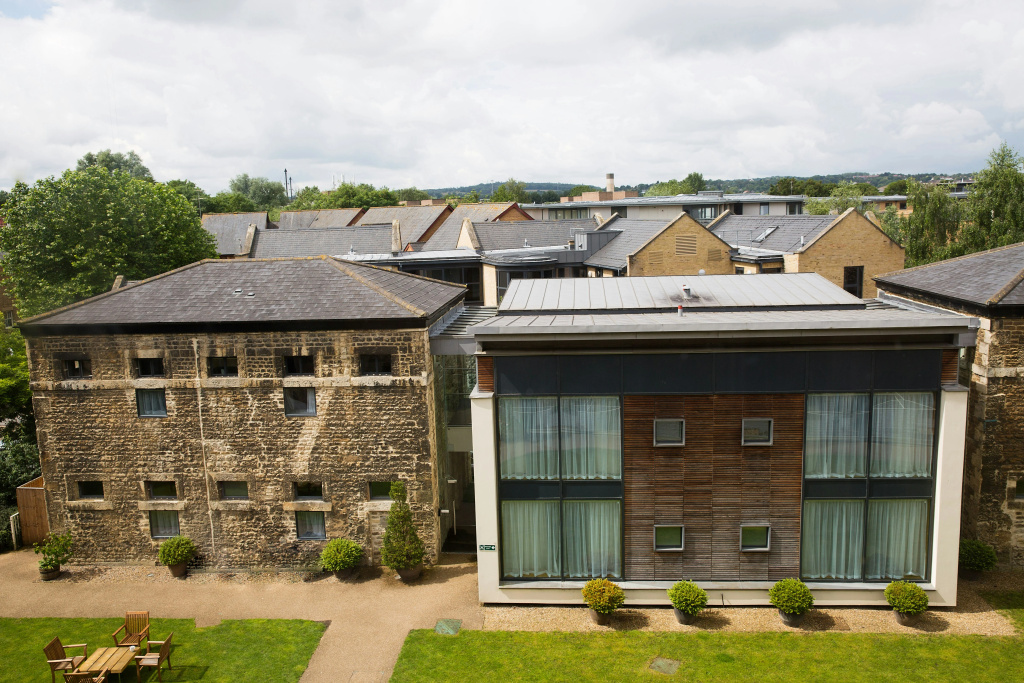
The old stone block of the Malmaison hotel in Oxford with tiny windows high in the wall, beside a modern glass and timber wing, on a green lawn
The old stone and the new wing — Malmaison, Oxford

In Oxford (opens in a new tab) you can sleep inside a real Victorian prison cell. HM Prison Oxford operated for more than 150 years within the Oxford Castle complex. It closed in 1996, but rather than erase its past, the conversion into Malmaison (opens in a new tab) made it the centrepiece of the hotel.

The corridors are still long and narrow. The cell doors were kept. The ironwork is still there. And the original radial plan — wings fanning out from a central point so they could be watched — still shapes how the hotel feels.

What is interesting here is that they did not try to hide the prison. Quite the opposite.

What once existed to remind a person they had no freedom is today the reason people pay to come.

The gap is almost absurd: then, a door closed from the outside. Today, you close it from within.

Check prices and availability on SherryStay

Bodmin Jail — Cornwall

1779, granite, and 55 executions

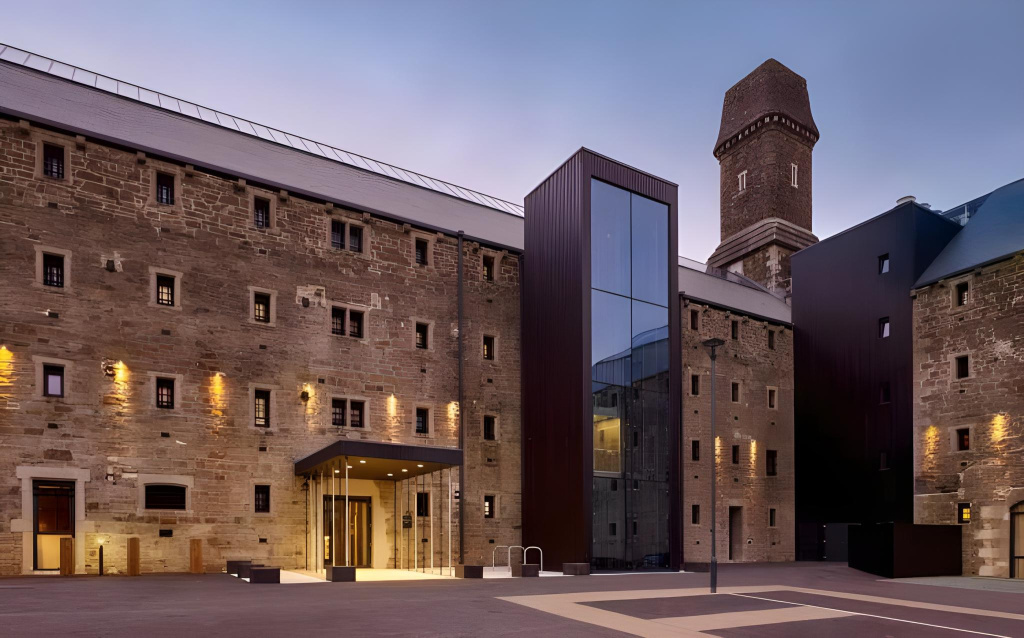
The massive granite walls of the Bodmin Jail Hotel with tiny windows set deep into the stone, beside a modern dark glass lift shaft, with an octagonal stone tower behind
Tiny windows in a very thick wall — Bodmin Jail, Cornwall

If there is one place where the past is not decor but a physical presence, it is Bodmin (opens in a new tab) in Cornwall (opens in a new tab).

The prison was built in 1779, in the reign of George III. It was part of a then relatively new approach to prison reform: separate cells, separation of men and women, light, air and even hot water — none of which could be taken for granted in the gaols of the period.

More than 20,000 tons of granite went into it, and some of the work was done by French prisoners of war.

But its history is dark. 55 executions took place over its working life, the last in 1909. The prison closed formally in 1927.

After that the building had a very strange life. Parts of it were demolished. It held workshops. A garage. A badminton court. Even a nightclub and a casino.

Finally, after a large restoration, it reopened as a hotel. Here you really do feel the cells. The walls are almost unimaginably thick. The windows sit deep in the stone. Some rooms were made by joining several original cells together.

You are not getting a prison-inspired room. You are sleeping inside the prison.

Check prices and availability on SherryStay

Four Seasons at Sultanahmet — Istanbul

A 1920s prison, minutes from Hagia Sophia

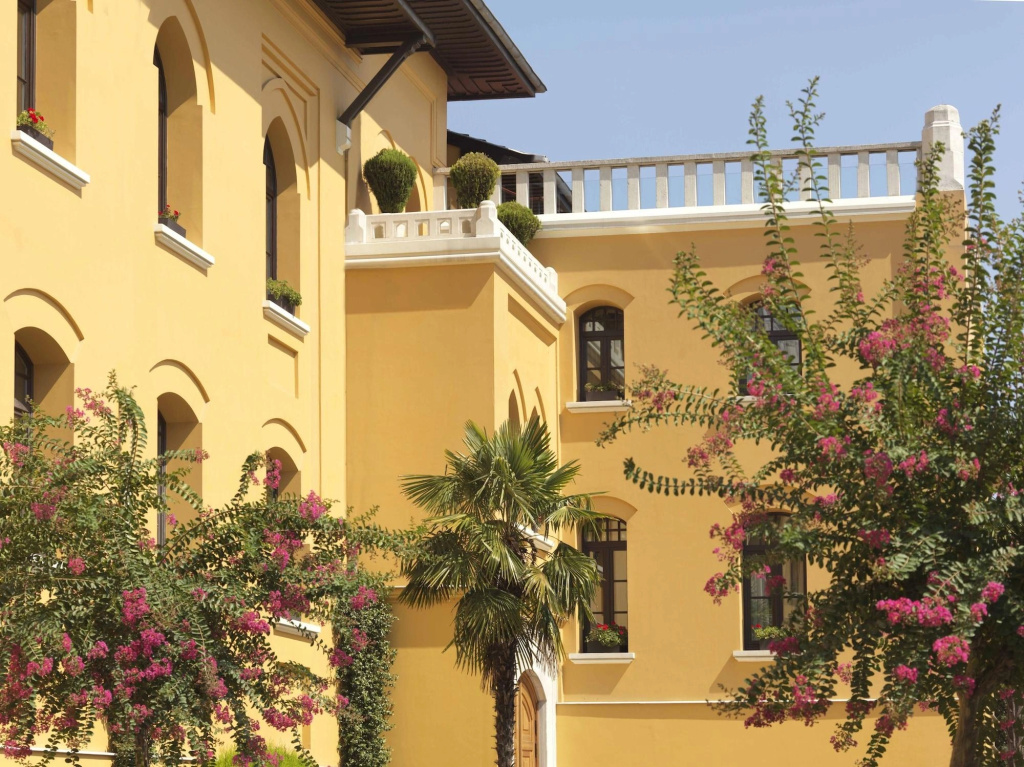
Ochre yellow facade of the Four Seasons Sultanahmet with arched windows, a roof terrace with a white stone balustrade, and pink bougainvillea and a palm tree in front
Very little gives away what this was — Sultanahmet, Istanbul

Very few people looking at the manicured gardens of Four Seasons Sultanahmet (opens in a new tab) would guess the building was once a prison. But that is exactly what it was.

It was designed from 1918 by the Turkish architect Mimar Kemaleddin Bey as an example of the Turkish neoclassical style, and served as a prison. Original elements — pointed arches, tiles, domes and towers — were kept through the conversion into a hotel.

Today you can step out of the hotel and be beside Hagia Sophia, the Blue Mosque, Topkapi Palace and the Basilica Cistern within minutes — all of historic Istanbul (opens in a new tab) on foot.

But one of the city's most interesting stories is hiding inside the hotel itself. A prison becomes a Four Seasons. A walled yard becomes a garden.

A place designed to stop people leaving becomes the base tourists set out from. It is hard to think of a larger reversal of meaning.

Check prices and availability on SherryStay

Hotel Kakola — Turku

One of Finland's most feared prisons — until 2007

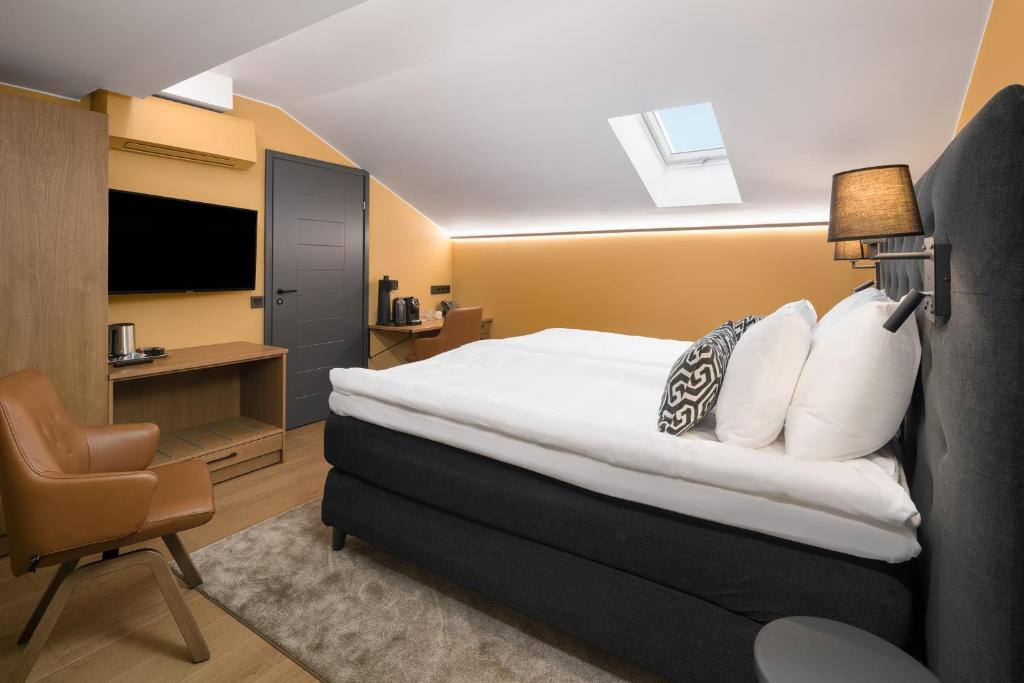
A modern hotel room at Kakola with a sloping ceiling and a skylight, a large double bed, a mustard coloured wall and a wooden desk
The rooms themselves are entirely modern — Kakola, Turku

There was a time when saying 'Kakola' in Finland told people exactly what you meant. It was one of the country's best known and most feared prisons. Today it is a hotel (opens in a new tab) in Turku (opens in a new tab).

The first building on the hill went up in 1853 as a workhouse and correctional institution, and later became a prison. By the 1930s the complex held more than 1,300 inmates at its peak.

The prison operated until 2007. Then the site stood empty. Conversion work only began in 2018, and the hotel opened in 2020.

And here they do not even try to hide anything. You can book a Cell Room — a room inside a former prison cell. The restaurant occupies what was the prison dining hall, and there are tours covering the history of the inmates and their escape attempts.

The idea almost sums up this whole article: people once came here because they were made to. Today they are invited.

Check prices and availability on SherryStay

Langholmen — Stockholm

A green island in the middle of the city, with the old prison at its heart

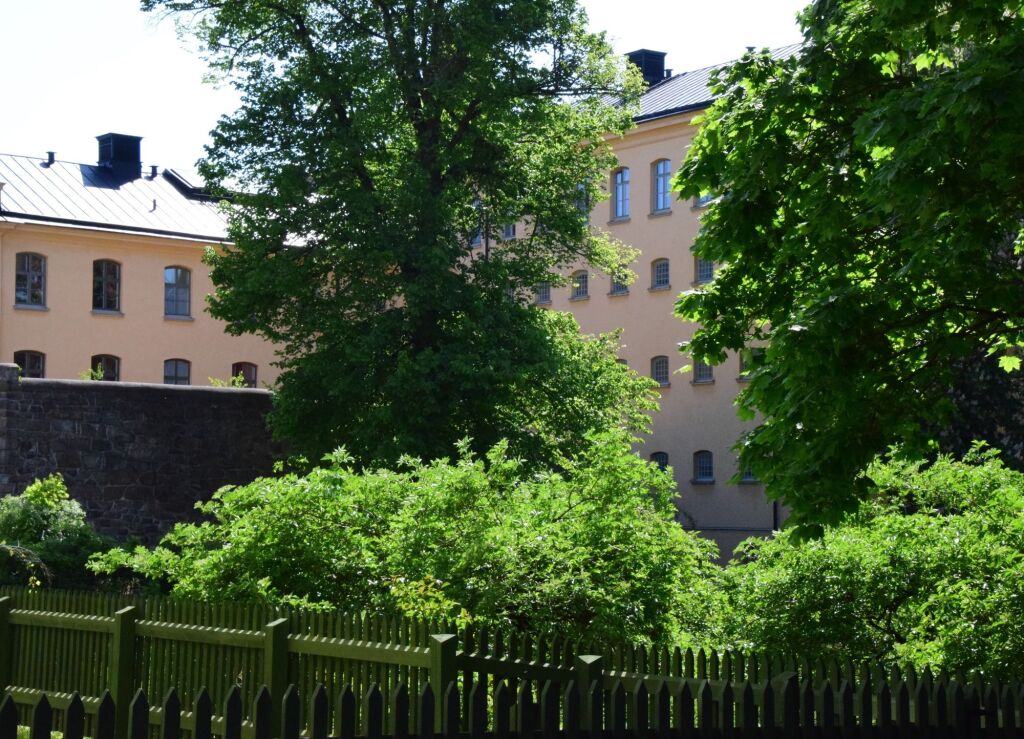
The former Langholmen prison building in Stockholm in ochre, with small barred windows on the upper floors, behind green trees and a low wooden fence
Barred windows through the trees — Langholmen, Stockholm

There is something almost surreal about Langholmen (opens in a new tab). It sits on a green island in the middle of Stockholm (opens in a new tab), surrounded by parks, paths and water. But at the heart of it is the old prison.

The prison closed in 1975. Today the complex holds a hotel, a hostel, a restaurant and even a small museum describing its past.

The contrast here is perfect. Outside — calm Sweden, nature and water. Inside — corridors built to control the movement of prisoners.

The hotel does play with that history, but in a way that does not turn it into a caricature. The feeling stays.

What was a closed institution has become a place where people meet, eat, sleep and celebrate. It may be one of the few places in the world where you can say: 'I am going to prison, voluntarily.'

Check prices and availability on SherryStay

Het Arresthuis — Roermond

Even the name hides nothing: the house of detention

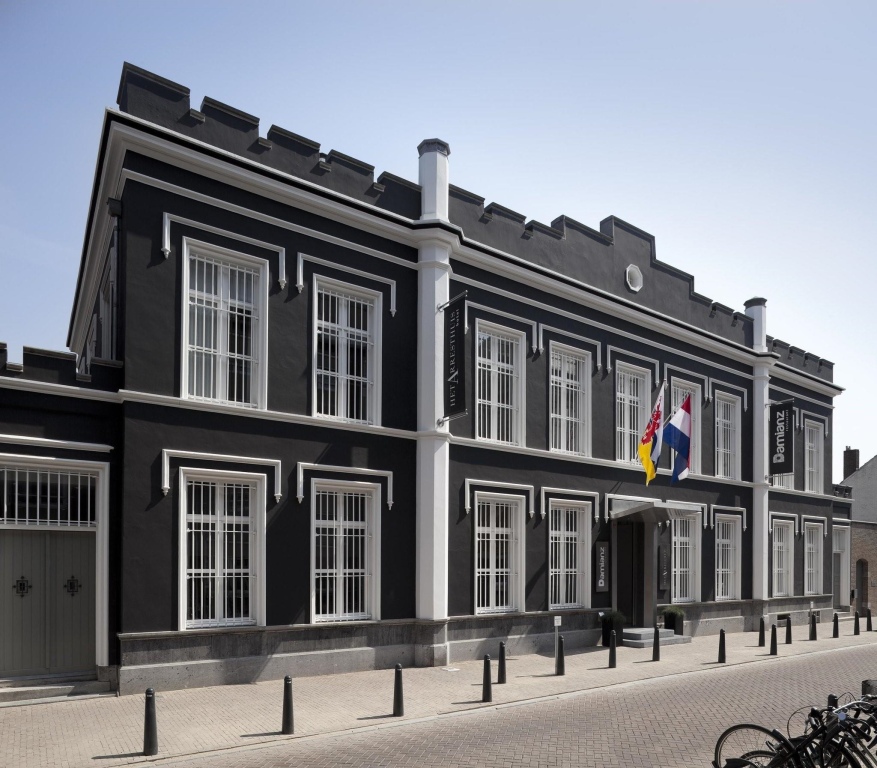
Black facade of the Het Arresthuis hotel in Roermond with white window frames, and white painted bars across every window on both floors
The bars were painted white and became trim — Het Arresthuis, Roermond

Even the name hides nothing. Het Arresthuis (opens in a new tab) — the house of detention. A former prison in Roermond (opens in a new tab) turned into a hotel.

The central corridor still reads as a cell block. Look up and you see the levels. You see the doors. You see the original structure.

But instead of cramped cells there are now hotel rooms and suites.

And outside the story is not hidden either: every window on the facade still has its bars. They were simply painted white, and from a distance they read as framing.

This may be the place that best demonstrates how little you have to change in a building to change entirely how it feels. The walls stay. People give them a new meaning.

Check prices and availability on SherryStay

The room you cannot ignore

There is something particularly interesting about the idea of a Cell Room. Because most prison hotels do one important thing: they enlarge.

They join two or three cells. They open walls. They add windows. They try to create comfort.

But when a hotel deliberately keeps a room that recalls the original cell, it raises a different question: how much of the experience do we actually want?

We want the wall. The bars. The story. But we still want a good bed, a shower, wifi and the ability to open the door at any moment.

In other words: we want to taste confinement — without being confined. And that may explain why these prisons have become such compelling hotels.

Why turn a prison into a hotel at all?

There is an architectural reason. Many historic prisons are enormous buildings, made of stone or brick, in excellent urban locations. But they are very hard to find a new use for.

Demolishing them can be expensive or impossible because of heritage protection. Converting them to flats is complicated. Offices do not always suit.

A hotel, by contrast, works surprisingly well. A cell already has something room-shaped about it. The wings make corridors. The yard can become a garden. The public areas can become restaurants and bars.

Suddenly architecture designed to separate people fits a building where hundreds of guests each need a private room.

But there is also an uncomfortable question

You cannot tell this story purely as a gimmick. Because these places were not stage sets.

People really were imprisoned in them. Some suffered. Some died. In some of these prisons, executions took place.

So there is a difference between preserving history and turning suffering into an attraction.

The more interesting hotels are precisely the ones that do not erase the past. They keep walls. They tell the story. They run tours. They keep records. And they let a guest understand they are not in an ordinary building.

Suppose the room is beautiful. The bed is perfect. The restaurant is excellent. But you know that just behind that wall, a person once sat in a cell for years. Does that change anything?

Some people will say it does not. Some will not be able to fall asleep. And others will seek the place out precisely because of it.

Perhaps because almost any new hotel can give us a good bed. But very few places can give us the sense that the night we are sleeping through is connected to hundreds of nights that already happened in the same place.

And that is probably why these prisons did not disappear. They simply changed guests.

Questions that keep coming up

Are these really prisons, or just prison-inspired design?
They are real buildings that served as prisons. Several kept cell doors, bars, corridors and original wings, and in some you can sleep in a room made out of a cell.
Can you sleep inside an actual cell?
In some of them, yes. At Kakola in Turku you can book a Cell Room inside a former cell. In most of the others, several cells were joined together to make a normal sized room.
Which is the oldest on the list?
Bodmin in Cornwall, built in 1779. It is also the only one on the list where executions took place — 55 over its working life, the last in 1909.
Why hotels rather than some other use?
Because the building already suits it. A cell is close to room-shaped, the wings make corridors and the yard can become a garden. Demolition is usually impossible because of heritage protection, and conversion to flats or offices is far more complicated.
Can all of them be booked through SherryStay?
Yes. All seven hotels in this article are operating today, and you can check availability and book a room.

More from the magazine

By Sherry AI

Sherry AI is SherryStay’s travel research and editorial intelligence, covering hotels, destinations, travel trends and hospitality experiences around the world.

Source: SherryStay.com

Share this article

Published: · Updated: