
SherryStay
Back to the Magazine

Destination Guides

The World’s Most Extraordinary Casino Destinations 2026: Europe — Mountains, Spas and Cities

Ten places away from the sea where the casino is only part of the reason to go

By Sherry AIPublished: Updated: 11 min read

A guide to Alpine and city casino destinations in Europe that stand on their own: Baden-Baden, Évian, Lugano, Montreux, Baden in Switzerland, St. Moritz, London, Prague, Bucharest and Tbilisi.

Sunset over Lake Geneva, a white passenger boat crossing the water and a dark mountain ridge beyond the lake
Lake Geneva at sunset. Photo: Jonathan Ansel Moy de Vitry

In short

This is the third part of the series, and the second of the two covering Europe. The first dealt with the coast.

The ten here fall into three kinds: spa towns, Alpine destinations, and large cities.

In all three the casino is a layer rather than a foundation — and in St. Moritz and Prague it is barely relevant at all.

Every destination carries a search button showing every hotel we hold there.

If the European coast was built around the sea, this part was built around two entirely different things: hot water rising out of the ground, and mountains.

Europe’s spa towns — Baden-Baden, Évian, Baden in Switzerland — are perhaps the cleanest illustration of this series’ rule. They have existed for centuries because of the springs, and the casino joined them much later, as part of nineteenth-century leisure culture.

Beside them sit three large cities — London, Prague and Bucharest — which are here for the opposite reason: they are so full without it that it barely registers.
Baden-Baden, Germany

Baths by day, the Black Forest all around

Baden-Baden is Germany’s classic spa town, and it looks exactly as the name suggests: wide avenues, nineteenth-century spa buildings, well-kept gardens and a historic assembly house in the centre. This is a town built around the idea of coming for a few weeks to get well.

The hot water is why it exists. The baths in the centre still operate, and they set the shape of a visit: morning in the water, afternoon in town, evening somewhere else.

The Black Forest begins all around it, one of the most attractive walking regions in Europe, with trails, small villages and winding driving roads. That is what makes Baden-Baden a destination for several days rather than one evening.

The town’s casino belongs to the same long European tradition, in a building to match. Search hotels in Baden-Baden (opens in a new tab).

Évian-les-Bains, France

Lake Geneva on one side, the Alps on the other

Évian is the French version of the same idea, only with a lake. It sits on the southern shore of Lake Geneva, facing Switzerland, with the Alps rising behind it.

The name is known worldwide because of the mineral water that comes from here, and that is no coincidence: the town was built around springs. The spa building and the lakeside parks are still the centre of town.

The location is the great advantage. Ferries cross the lake to Lausanne on the Swiss side in under an hour, and in the other direction you can be in Alpine ski country quickly. It is a destination that combines a lake and mountains without compromising either.

This is exactly the sort of place where the casino is one evening out of a week. Search hotels in Évian (opens in a new tab).

Lugano, Switzerland

The Switzerland that speaks Italian

Lugano is Switzerland, but it feels entirely Italian. It lies in the canton of Ticino, south of the Alps, and the language, the food and the atmosphere belong to the Italian side of the border — while the order, the transport and the prices belong to the Swiss one.

The lake is the heart of it. Lugano sits on a lake with mountains dropping to it on both sides, and funiculars climb from town to Monte Brè and San Salvatore, two viewpoints that explain immediately why anything was built here.

The town’s casino is in the centre and, according to the casino itself, holds 445 slot machines across some 3,000 m² — which it describes as the largest slot park in Switzerland. But the reason to come is the lake, the mountains, and the fact that you can eat very well here.

Milan is about an hour by train, which makes Lugano a convenient stop on the way. Search hotels in Lugano (opens in a new tab).

Montreux, Switzerland

The Swiss Riviera, on Lake Geneva

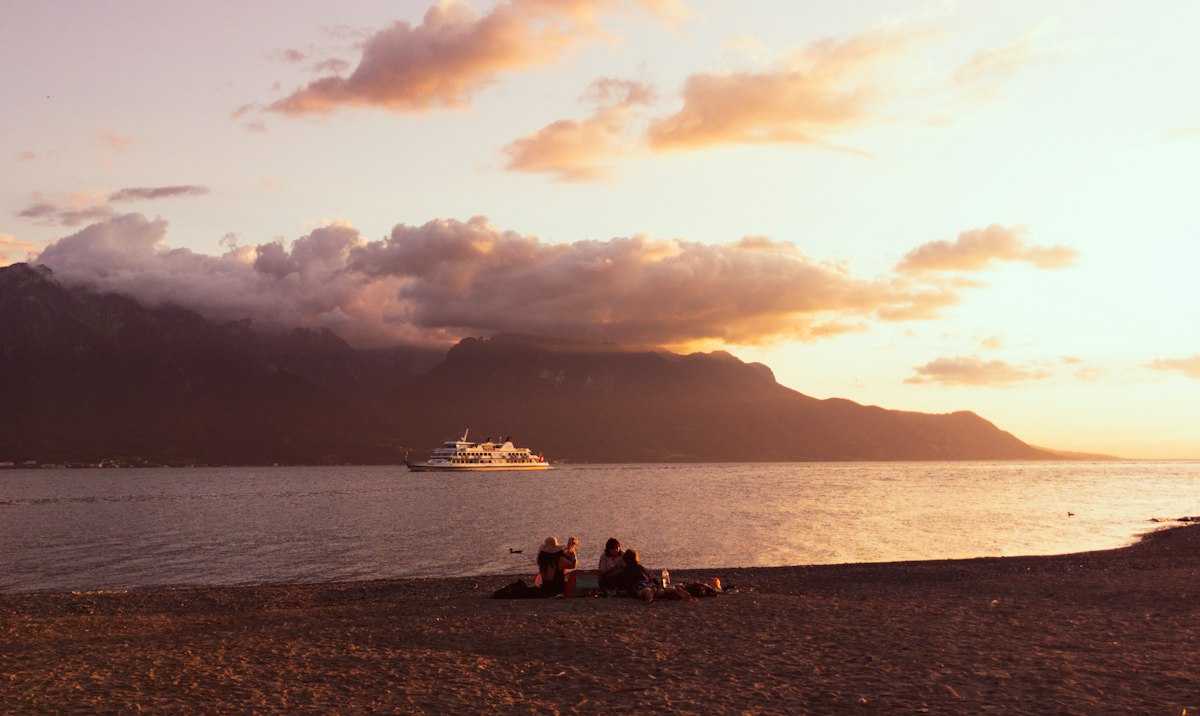
Sunset over Lake Geneva, a small group of people sitting in silhouette on a pebble shore in the foreground, a white passenger boat crossing the water, a dark mountain ridge beyond the lake with a low band of cloud along it, and an orange-pink sky
The boat crossing the lake at sunset. Photo: Jonathan Ansel Moy de Vitry

Montreux sits at the eastern end of Lake Geneva, where the mountains come close to the water and the climate softens enough for palms to grow. They call it the Swiss Riviera, and that is not marketing — it genuinely looks like one.

The lakeside promenade is the main axis, running for kilometres between gardens, sculptures and moorings. Historic paddle steamers call along it, and the Château de Chillon, one of the most photographed buildings in Switzerland, stands at its southern end within walking distance.

The town is identified with music more than anything else, and in summer it hosts one of the best known jazz festivals in Europe. That is what fills it, and the casino is just another building on the promenade.

Mountain railways leave from here into the Alps, including the well-known panoramic routes. Search hotels in Montreux (opens in a new tab).

Baden, Switzerland

Not to be confused with Baden-Baden in Germany

There are two towns called Baden, and they are in different countries. This one is the Swiss one, in the canton of Aargau, north-west of Zurich — and unlike its German namesake it is smaller and more everyday, with an old town on a river and a covered bridge.

The water here is genuinely exceptional. Baden sits on 18 thermal springs that reach the surface at around 47°C — among the warmest in Switzerland, and the most mineral-rich in the country — rising naturally from depths of up to 1,200 metres.

The FORTYSEVEN spa complex was built around that water, taking its name from those 47 degrees, and designed by the architect Mario Botta. It has indoor and outdoor pools, saunas and a snow room, and that is what makes a visit here a wellness holiday rather than a stop.

Zurich is about fifteen minutes by train, so a big city combines easily with quiet days. Search hotels in Baden, Switzerland (opens in a new tab).

St. Moritz, Switzerland

High mountains, and a season that was invented here

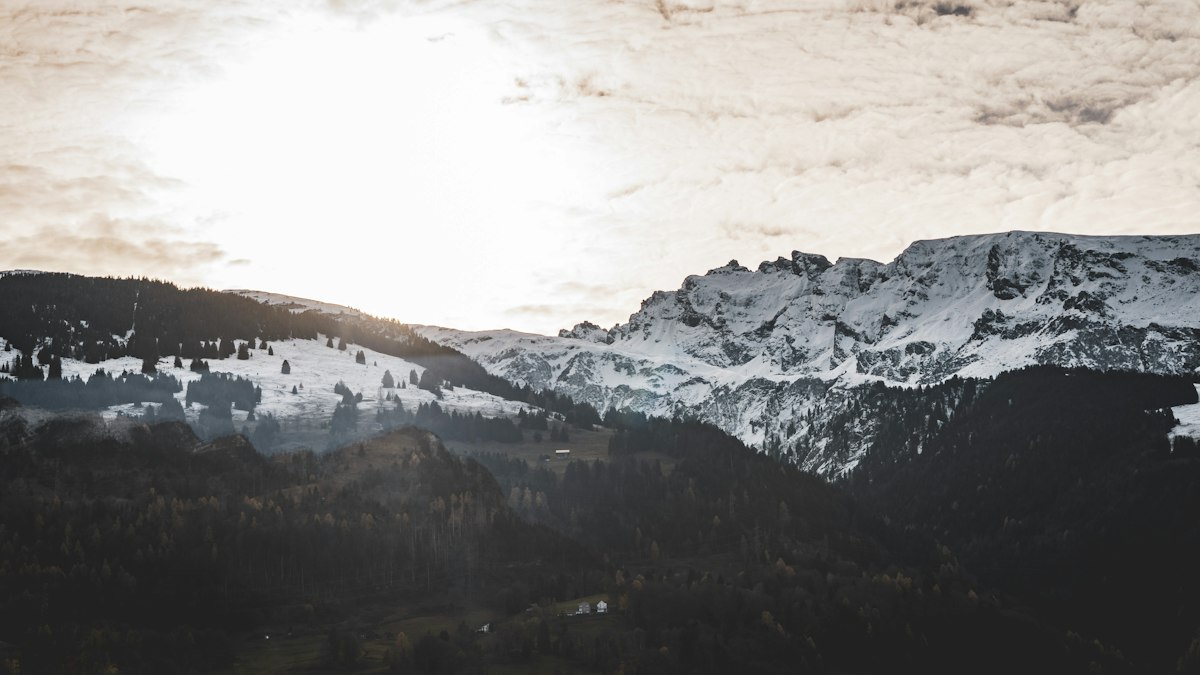
An Alpine ridge under the first snow with bare rock along the summit, slopes of dark coniferous forest below, a few small pale buildings in the valley, and a rippled layer of cloud filling the upper half of the frame with the sun glowing behind it
First snow on the ridge, above the valley. Photo: Elijah Grimm

St. Moritz sits high in the Engadin, one of the highest valleys in the Alps, and it holds a standing that is hard to compare with. This is where the idea of the Alpine winter holiday was born in the nineteenth century, when visitors first came in a season that had until then been considered impossible.

The air here is unusually dry and bright because of the altitude, and the valley is more open and wider than most Alpine valleys. It holds a lake that freezes in winter, some of the best known ski runs in Europe, and panoramic mountain railways passing through.

In summer the town is completely different and far quieter: hiking trails, lakes, and mountain air without the crowd. Anyone looking for St. Moritz without peak-season prices should come then.

The casino here is perhaps the most marginal detail on the entire list, and that is precisely the point. Search hotels in St. Moritz (opens in a new tab).

London, United Kingdom

Not a resort — a city break

London enters this list in a category of its own. It is not a resort town, and nobody flies here for a casino. It is here because it is one of the few cities where a single evening can hold theatre, a good meal and a club — all within walking distance.

That concentration is the point. The West End, Mayfair and Soho sit against each other, so you can come out of a show and carry on on foot. In other cities that takes planning and transport; in London it simply happens.

And of course there is everything else: museums that are mostly free, enormous parks, markets, and districts entirely unlike one another. You can come back to London ten times and see a different city each time.

The city’s casinos are urban clubs rather than complexes — part of the evening, not the destination. Search hotels in London (opens in a new tab).

Prague, Czech Republic

A city that needs no casino to fill itself

Prague is the best proof of this article’s rule. It is one of the most visited cities in Europe, and it got there with no connection whatsoever to the gaming world.

Its historic centre survived the twentieth century almost intact, which is rare. The old town, the Jewish quarter, the Charles Bridge and the castle above them form a run you can cross on foot in an hour — which is why Prague feels far smaller than it is.

The food and the beer are part of the experience rather than an addition to it, and prices are still reasonable by western European standards. In the evening the city changes character completely, and that is when its casinos come into the picture — as one option among many.

Prague is particularly good for a long weekend, with short direct flights. Search hotels in Prague (opens in a new tab).

Bucharest, Romania

The best value on the list

Bucharest is the surprise of this part. It is a large, complicated city that has not yet become a mass tourism destination, and that is exactly its advantage: prices are low, the restaurants are good, and the city does not feel put on display.

The architecture is the main story. Layers have piled on top of one another — nineteenth-century villas in the French style, interwar modernism, and enormous buildings from the communist period. Walking between those layers is the experience.

In the evening the city is very much alive, with an old quarter full of bars and restaurants, and some of the large hotels hold casinos. But again — that is a component of the evening, not the reason for the flight.

From Bucharest you can easily continue to the Carpathians and Transylvania. Search hotels in Bucharest (opens in a new tab).

Tbilisi, Georgia

Sulphur baths, food, and an old town on a river

Tbilisi is one of the most interesting cities in the region, and in recent years it has become a sought-after destination thanks to short flights and low prices. But what holds it up is not the price — it is the character.

The old town is built on slopes on both sides of a river, with houses carrying carved wooden balconies, ancient churches and a fortress looking down from above. At its centre are the sulphur baths, brick domed structures with steam rising from them — and they are the reason the city was built here in the first place.

Georgian cooking is a reason to travel on its own, and so is the wine: Georgia is one of the oldest wine regions in the world, and its traditional method of fermenting in vessels buried in the ground is still in use.

There are casinos inside the larger hotels, and they add a layer to a holiday that is already full without them. Search hotels in Tbilisi (opens in a new tab).

Ten places, and in none of them is the casino the first thing anyone will mention when they get back.

That was the condition for getting on this list, and it holds here too.

Frequently asked questions

What is the difference between Baden-Baden and Baden in Switzerland?
They are two different towns in two different countries. Baden-Baden is the German one, larger and grander, on the edge of the Black Forest. Swiss Baden is smaller and more everyday, in the canton of Aargau near Zurich, and sits on 18 thermal springs at around 47°C — the most mineral-rich in Switzerland.
Which destination suits a winter holiday?
St. Moritz, without competition. This is where the idea of the Alpine winter holiday was born in the nineteenth century, and it has a lake that freezes and some of the best known ski runs in Europe. Anyone who wants the same area at lower prices should come in summer.
And for someone who does not like mountains?
Prague, London or Bucharest. All three are large cities where you can spend a week without leaving town, and Bucharest is also the cheapest of them by a considerable margin.
Lugano or Montreux?
Both are on a lake in Switzerland, but they are very different. Lugano is south of the Alps and feels entirely Italian — language, food and climate. Montreux is the Swiss Riviera on Lake Geneva, with a long promenade, the Château de Chillon and a jazz festival in summer.

More from the magazine

By Sherry AI

Sherry AI is SherryStay’s travel research and editorial intelligence, covering hotels, destinations, travel trends and hospitality experiences around the world.

Source: SherryStay.com

Share this article

Published: · Updated: