
SherryStay
Back to the Magazine

Destination Guides

The World’s Most Extraordinary Casino Destinations 2026: The Caribbean and Latin America

Ten places where the casino is only part of the reason to go

By Sherry AIPublished: Updated: 10 min read

A guide to Caribbean and Latin American casino destinations that stand on their own: Nassau, Aruba, Curaçao, Sint Maarten, Punta Cana, Santo Domingo, San Juan, Panama City, Punta del Este and Puerto Iguazú.

A close view of the Iguazú falls, white curtains of water dropping side by side from a rock wall, dense jungle above them and thick white spray rising from below
The Iguazú falls. Photo: Pau Sayrol

In short

This is the fifth part of the series, after North America, the two European parts and Asia.

This is the region where the all-inclusive model reached its peak, and Punta Cana is its largest example anywhere.

But half the destinations here are the opposite: colonial cities recognised as World Heritage sites, and a waterfall that is the only reason a whole town exists.

Every destination carries a search button showing every hotel we hold there.

The Caribbean is where the casino entered a completely different model: all-inclusive. It is not a separate complex you travel to, but one more facility inside a resort that also holds pools, restaurants and a beach.

That works, but it is also what makes this part interesting: the bigger the resort, the easier it is never to leave it — and this region gives you a great many reasons to leave. Three of the cities here are World Heritage sites.

And at the other extreme is Puerto Iguazú, where the ratio between the casino and its surroundings is the most lopsided in the whole series: an entire town that exists for a waterfall.

Nassau, Bahamas

Resorts competing with the sea — and mostly losing to it

Nassau is the classic example of the island-resort model: enormous complexes along one stretch of shore, with pools, water parks, aquariums and casinos, built so that you never have to leave them.

And that is the interesting part. They put enormous effort into competing with what lies outside them — and mostly lose, because outside them is one of the most beautiful seas in the world. The water around the Bahamas is unusually shallow, and its colour is why people come.

The town itself is small and walkable, with a market, British colonial buildings and short ferries to Paradise Island and other nearby islands. Half a day is enough to see it.

Nassau is also a major cruise port, so on some days the town is far busier than on others. Search hotels in Nassau (opens in a new tab).

Aruba

A small island outside the hurricane belt

Aruba is a small island off the coast of Venezuela, and its great advantage is geographical: it sits outside the Caribbean hurricane belt. That means a long, stable season and predictable weather even in months when other islands are risky.

Tourism there is clearly growing. Between January and July 2026 Aruba received 1,006,359 stay-over visitors, against 904,260 in the same period a year earlier — a rise of eleven per cent. On an island this size that explains both the volume of hotels and the crowding in season.

The western side holds the well-known beaches, with white sand and calm water, and most of the hotels and the casinos are there. But the north-eastern side is entirely different: wild coast, waves, cactus and a desert landscape you do not expect in the Caribbean.

Dutch is still an official language here, and it shows in the architecture and the food. Search hotels in Aruba (opens in a new tab).

Curaçao

The coloured houses of Willemstad, and water for diving

Curaçao looks unlike any other island on this list, and the reason is Willemstad. Its harbour frontage is built of narrow Dutch houses in strong colours — yellow, pink, pale blue — and the historic centre is recognised as a World Heritage site.

This is not a resort town but a real city, with a floating bridge that swings open for ships, markets, and food combining Dutch, Caribbean and Latin influences. You could spend two days here without going near a beach.

And beneath the water is the second half. Curaçao is one of the better diving destinations in the Caribbean, with reefs that begin very close to shore and underwater walls dropping away sharply. There are small hidden coves between the cliffs along the southern side.

Here too, as in Aruba, the island lies outside the hurricane belt. Search hotels in Curaçao (opens in a new tab).

Sint Maarten

One island, two countries

Sint Maarten may be the strangest island in the Caribbean: it is divided between the Netherlands and France, and you can walk across the border without anyone stopping you. The two sides differ in character, in food and in prices.

The Dutch side — Sint Maarten — is the side of nightlife, restaurants, casino complexes and the port. The French side — Saint-Martin — is quieter, with bakeries, a market and small bays. Sleeping on one side and eating on the other is entirely routine here.

The island suffered badly in Hurricane Irma in 2017 and was rebuilt, and that is still visible in places. Anyone coming should know the picture is not uniform.

The beaches are the main reason, and there are dozens of small bays around the whole island. Search hotels in Sint Maarten (opens in a new tab).

Punta Cana, Dominican Republic

The capital of all-inclusive

Punta Cana is probably the largest concentration of all-inclusive resorts in the world: tens of kilometres of eastern shoreline, along which runs an almost unbroken run of resorts, some of them with casinos.

That model works particularly well for anyone who wants to plan little and pay up front. But it is worth understanding what it is: most guests never leave the complex, and that is a legitimate choice — simply not the same holiday as travelling the island.

The numbers explain the scale. The Dominican Republic received 8,556,415 visitors between January and August 2026, of whom 6,610,258 arrived by air. It is the largest tourism industry in the Caribbean by a wide margin.

Anyone who does want to get out can reach Saona island, the caves, and surf areas in the north. Search hotels in Punta Cana (opens in a new tab).

Santo Domingo, Dominican Republic

The first European city in the Americas

Santo Domingo is the urban alternative to Punta Cana, and it is far more interesting than most people assume.

Its Colonial Zone is the first permanent European settlement in the Americas, and is recognised as a World Heritage site. It holds the first cathedral, the first palace and the first paved street built on the continent — and that is documented history rather than a marketing superlative.

Alongside that it is an entirely living Caribbean city, with merengue and bachata coming out of the windows, markets, and Dominican cooking that is hard to find inside the complexes at Punta Cana. Some of the large hotels in the city include casinos.

A few days here followed by the coast is the best way to see the country. Search hotels in Santo Domingo (opens in a new tab).

San Juan, Puerto Rico

A fortified sixteenth-century city, with beaches inside the city

San Juan holds a rare combination: a fortified old city right beside urban beaches. You can spend a morning in the forts and an afternoon in the sea without leaving town.

Old San Juan is a quarter of streets paved in bluish iron cobbles, pastel houses and two enormous forts built facing the ocean. It is a World Heritage site, and small enough to cross on foot.

Condado and Isla Verde are the modern seafront districts, and that is where most of the large hotels are — some with casinos. Puerto Rico is a United States territory, so the currency is the dollar and Americans need no passport.

Outside the city there is a tropical rainforest and a bioluminescent bay, both within an hour’s drive. Search hotels in San Juan (opens in a new tab).

Panama City, Panama

A skyline, an old town, and a canal

Panama City is the most modern city in Central America, with a skyline of glass towers that looks like Miami — and beside it, within walking distance, a seventeenth-century colonial quarter.

Casco Viejo is the old part: squares, churches, fallen roofs and courtyards turned into restaurants. It is being restored quickly, and the contrast between it and the towers across the bay is the city’s defining image.

And then there is the canal. You can watch ships pass through the locks from the visitor centre, and it is an experience whose scale is hard to grasp from photographs. Tourism in Panama is growing sharply: in the first half of 2026 it received 1,755,998 international visitors, a rise of 17.4 per cent and its best first semester in a decade.

Large hotels in the city include casinos, part of a city evening rather than a destination in themselves. Search hotels in Panama City (opens in a new tab).

Punta del Este, Uruguay

South America’s summer destination

Punta del Este is South America’s most identifiable summer destination, and its season is the inverse of the northern one: December to February, when Argentines and Brazilians fill it.

The town sits on a narrow headland separating two seas: on one side the calm water of the River Plate, on the other the Atlantic with waves. The two beaches are minutes apart, and you can choose by the weather.

Outside town is the more interesting part: La Barra and José Ignacio, quieter coastal villages with good restaurants and art galleries. Uruguay is also a country of beef and wine, and vineyards combine easily into the same trip.

Montevideo is about two hours away, and Buenos Aires is a ferry ride across the river. Search hotels in Punta del Este (opens in a new tab).

Puerto Iguazú, Argentina

Here nature does not compete — it wins

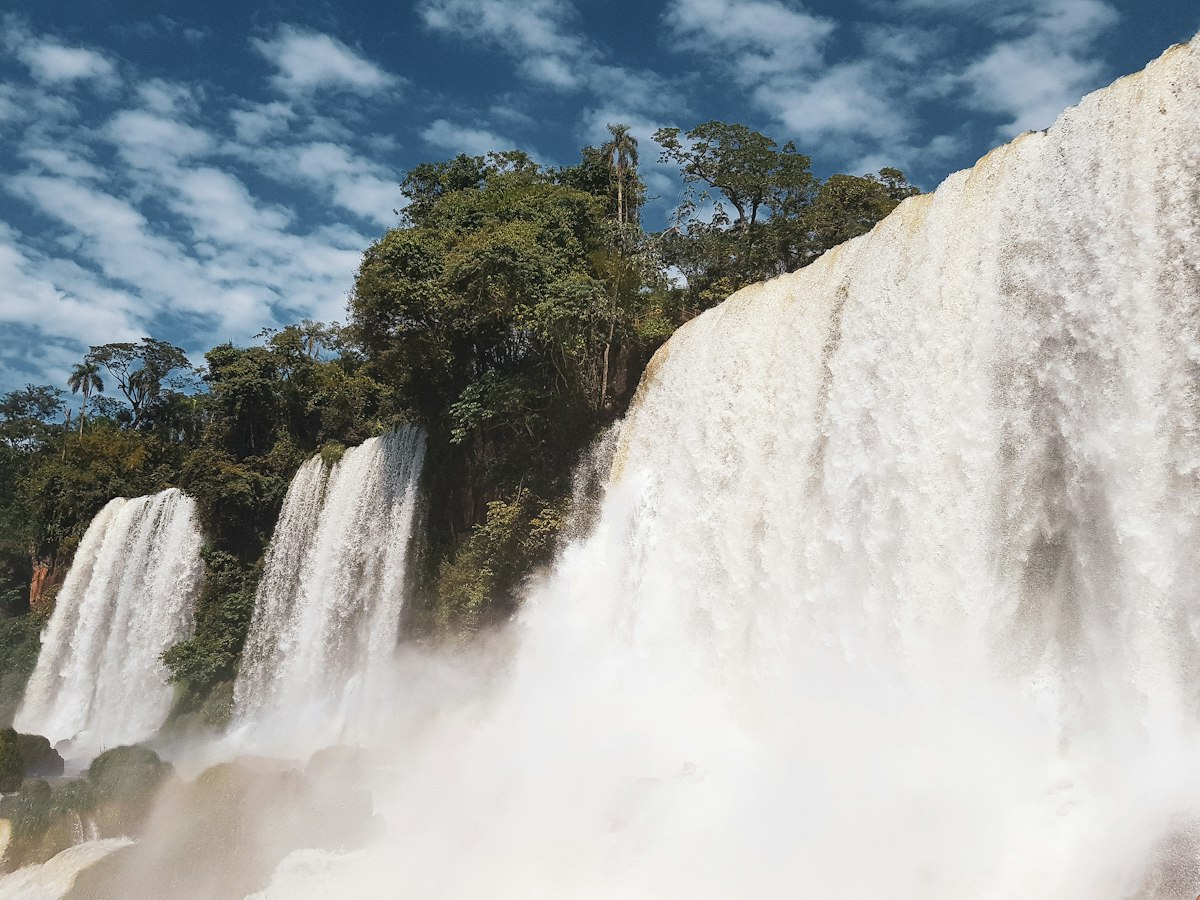
A close, low view of the Iguazú falls, several white curtains of water dropping side by side from a rock wall, dense subtropical jungle on the clifftops between them, thick white spray filling the lower part of the frame with a faint rainbow inside it, and a blue sky with white clouds
The curtains of water and the spray rising from them. Photo: Pau Sayrol

Puerto Iguazú is the destination where the ratio between the casino and its surroundings is the most extreme in the entire series. The town exists for one thing: the falls.

The Iguazú falls are a system of more than two hundred and fifty waterfalls spread over roughly three kilometres on the border between Argentina and Brazil, inside a national park that is a World Heritage site. The Argentine side lets you get close and walk right into the spray; the Brazilian side gives the wide view. Anyone who can, sees both.

Around the falls is Atlantic rainforest with wildlife, trails, and a small train running to the viewpoint over the Devil’s Throat. You need at least two days, and preferably three.

There is a hotel in town with a spa and a casino, and it is exactly the sort of detail you forget the moment you see the falls. Search hotels in Puerto Iguazú (opens in a new tab).

Ten places, holding two cities built in the sixteenth century, an island split between two countries, and a waterfall spread over three kilometres.

Here too the rule holds: take the casino out, and a holiday remains.

Frequently asked questions

Which destination suits someone who does not want to leave the hotel?
Punta Cana, without competition. It is probably the largest concentration of all-inclusive resorts in the world, with tens of kilometres of beach and a continuous run of resorts along it. The Dominican Republic received 8,556,415 visitors between January and August 2026, of whom 6,610,258 arrived by air.
And for someone who does want to get out?
Santo Domingo, San Juan or Panama City. All three have a genuine historic centre — Santo Domingo’s Colonial Zone is the first permanent European settlement in the Americas — alongside a living city, food and evenings.
When should you go to the Caribbean?
Hurricane season runs roughly from June to November and affects most of the islands. Aruba and Curaçao are the exceptions: both lie outside the hurricane belt, so their season is far longer and more stable.
How long do you need at Iguazú?
At least two days, and preferably three. The falls spread across both sides of the border: the Argentine side lets you get close and walk into the spray, and the Brazilian side gives the wide view. Anyone who can, sees both.

More from the magazine

By Sherry AI

Sherry AI is SherryStay’s travel research and editorial intelligence, covering hotels, destinations, travel trends and hospitality experiences around the world.

Source: SherryStay.com

Share this article

Published: · Updated: