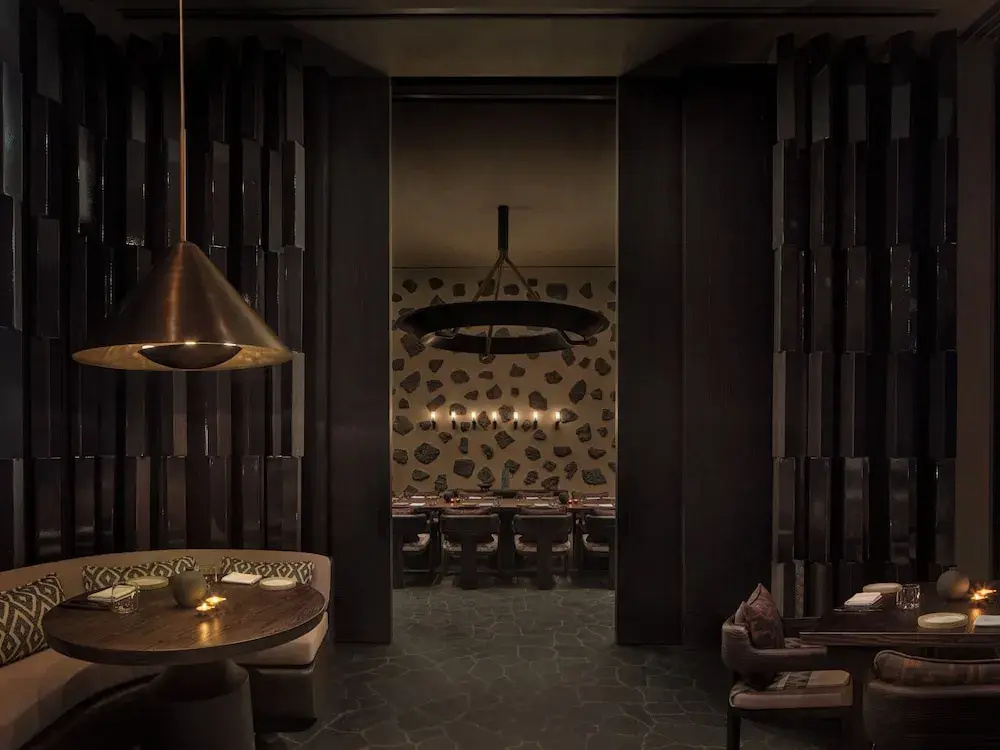
Some hotels try to impress us with marble, chandeliers and infinity pools.
And some hotels make us stop for a moment and ask:
Is this what hotels will look like in twenty years?
In 2026 the future of hospitality is no longer confined to science fiction. You can sleep inside metal spheres that appear to hover above the Red Sea, enter your room by facial recognition, control the lights and curtains from bed, hand your suitcase to a robot, or stay in a hotel that generates a substantial share of its own energy.
But a genuinely futuristic hotel is not simply a hotel with a lot of screens.
The most interesting ones are those using technology, architecture and sustainability to change the guest experience itself.
We gathered nine hotels around the world that offer nine different answers to a single question:
A hotel that looks as though a spacecraft landed at sea
Best for: Couples, honeymoons, architecture lovers and anyone who wants a hotel that is a destination in itself.
If one hotel on this list looks as though it arrived from the year 2050, it is probably Shebara Resort.
It sits on a private island in the Red Sea region of Saudi Arabia, and the first thing that catches the eye is the row of round, mirrored villas positioned above the water.
The villas are wrapped in a polished metal shell that reflects the colours of the sea and the sky. From a distance they look like pearls, giant bubbles or futuristic capsules floating above the lagoon.
The design is no accident: the architects at Killa Design wanted the structures to reflect their surroundings rather than compete with them. Some of the villas were even built and completed off-site and only then moved into position, to limit the disturbance to the delicate marine system.
The future here is not only the design
Behind the spacecraft looks sits an advanced environmental approach.
The resort was designed to run largely on independent infrastructure, including a central solar farm, water desalination, and water and waste treatment.
And this may be one of the most interesting things about Shebara:
it shows that a futuristic hotel does not have to be full of robots.
Sometimes the future is simply a hotel built in a completely different way.
Why it made the list
Because it combines architecture that looks almost unreal with new thinking about how a resort can fit into nature.
Best for: Technology lovers, people who work in AI, and anyone visiting the Hangzhou area who wants to see how Alibaba imagines hospitality.
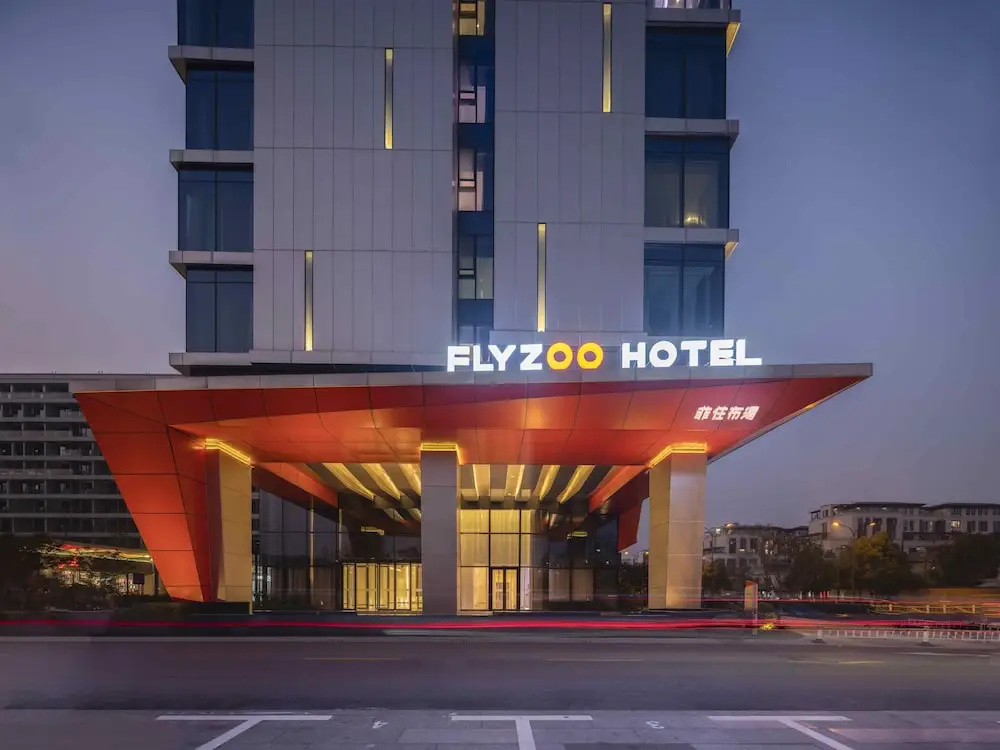
At Alibaba's FlyZoo Hotel in Hangzhou they set out to answer a different question:
how many of the things we do in a hotel actually need a human being?
The result is one of the world's best-known experiments in technology-led hospitality.
Guests can use facial recognition as part of the check-in process and to use various services, and the hotel has built in AI systems, automation and robots to carry out some of the service tasks.
The facial-recognition systems have even been used to open doors and to access various facilities in the hotel.
Smart Home capabilities are built into the rooms, so the lighting, curtains, television and temperature, among other things, can be controlled by voice command.
Robots are also used for tasks such as delivering food, and robotic systems have been put to work in the restaurant as part of the experience.
So there are no people here?
There are, in fact.
And that matters.
Despite all the automation, the hotel is not a world without staff. There is still a team handling housekeeping, the kitchen, and guests who would rather use an ordinary check-in.
And that may be a far more realistic glimpse of the future:
not a hotel where machines replace people entirely, but one where they take on some of the technical tasks.
Why it made the list
Because FlyZoo is one of the places where you can genuinely experience how AI, facial recognition, robotics and Smart Home come together into a single hospitality experience.
A building that looks as though the usual rules of architecture do not apply to it
Best for: Architecture and design lovers, Macau, and exceptional luxury experiences.
Even before you walk into Morpheus, it is clear this is no ordinary hotel.
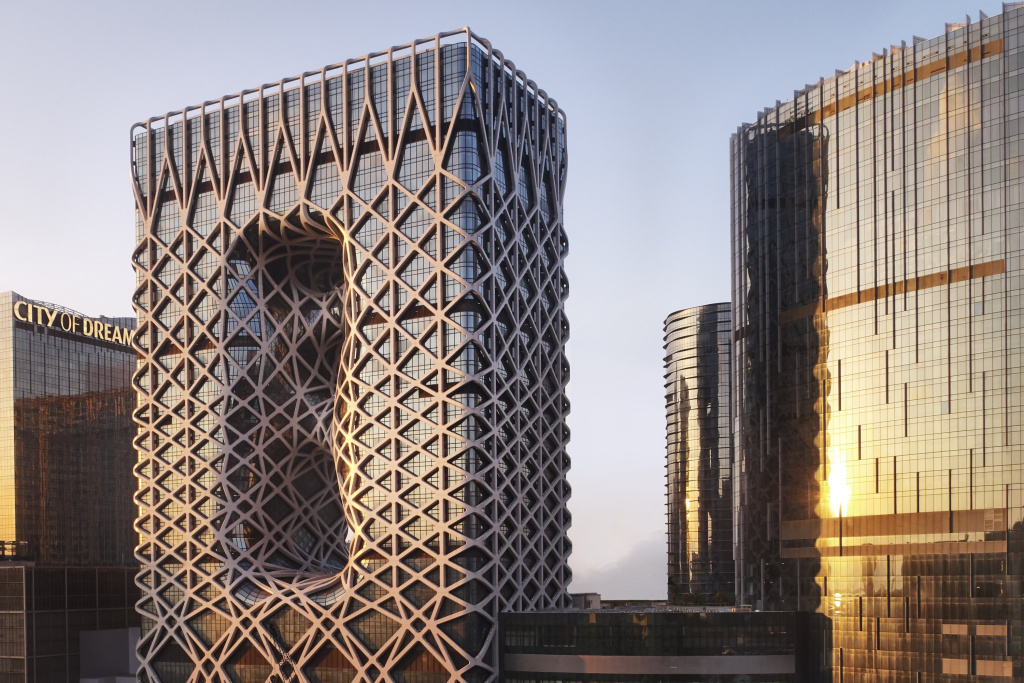
The building in Macau was designed by Zaha Hadid Architects and looks like two enormous masses that were cut, pulled open and rejoined by an external structural system.
Three vast voids cross the centre of the building, and the bridges connecting them create an almost cinematic feel.
The project is considered a pioneering high-rise in its use of a free-form exoskeleton, and the structure makes it possible to create large interior areas without a forest of columns interrupting the space.
The hotel has hundreds of rooms, suites and villas, alongside restaurants, a spa and a rooftop pool. Technology is built into the rooms themselves to improve comfort.
Why does it feel futuristic?
Because here the future is first of all in the shape of the building.
This is not an ordinary hotel with a few gadgets added inside.
The whole structure is a statement about what becomes possible when advanced design software, engineering and architecture work together.
SherryStay Tip
This is the kind of hotel worth seeing both in daylight and after dark. The structure changes completely once the lighting and the city around it come into play.
Best for: Architecture and sustainability lovers, Design Hotels, and trips around New England.
If FlyZoo shows us the future of automation, Hotel Marcel points in a completely different direction:
a future in which the hotel itself has to be far more energy-efficient.
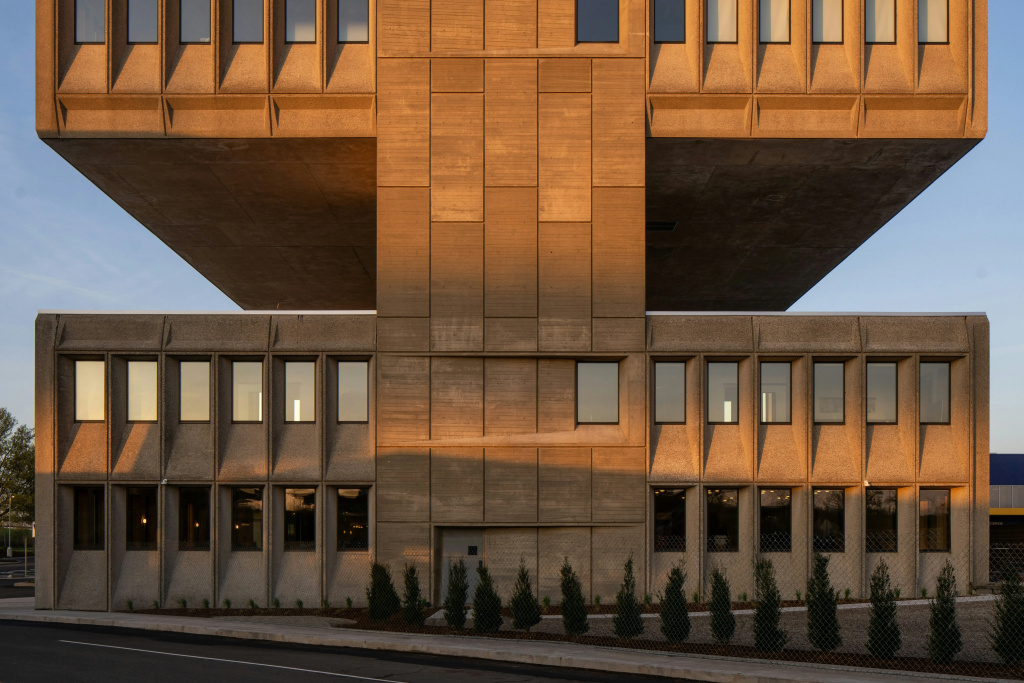
The hotel occupies a modernist building designed by the architect Marcel Breuer, restored and turned into a hotel with an exceptional emphasis on sustainability.
Hotel Marcel is an all-electric hotel, with no routine use of fossil fuels to run its core systems, and it uses more than a thousand solar panels installed on the roof and over the parking areas.
It also has energy storage systems, a microgrid, and a Power-over-Ethernet system controlling the lighting and some of the other systems.
Why is this futuristic?
Because over the coming decade, part of the big revolution in hotels will not be something a guest can photograph for Instagram.
It will happen behind the walls.
Heating.
Cooling.
Electricity.
Water.
Energy storage.
Efficient building design.
Hotel Marcel is a good example of a hotel where the technology is not there only to impress the guest, but to change how the entire building works.
The future where the city and the jungle become one building
Best for: Couples, design lovers, green architecture, and a city break in Singapore.
There is something almost paradoxical about PARKROYAL COLLECTION Pickering.
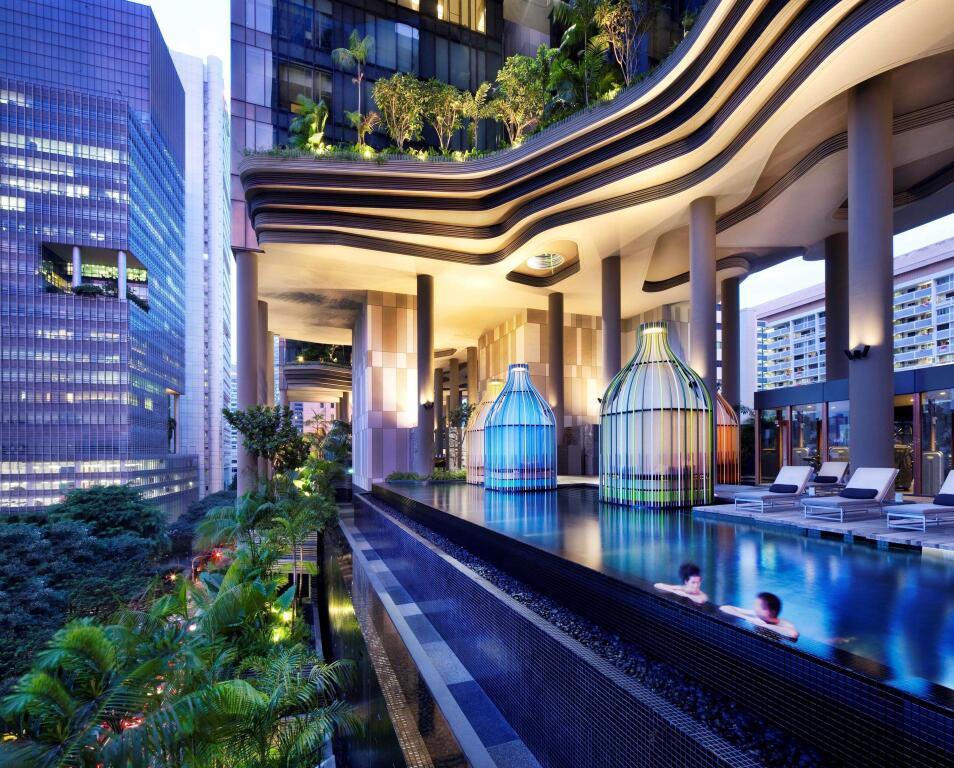
It stands in the heart of one of the most advanced and densest cities in the world, yet parts of it look like a tropical forest that climbed up a building.
The hotel was designed by the practice WOHA as a vision of a “Hotel in a Garden”.
Around 15,000 sqm of sky gardens, vertical planting, pools and waterfalls are built into the structure. The planted area is larger than the plot the hotel stands on.
But the greenery is not just decoration.
The hotel also incorporates rainwater collection systems, energy-saving solutions and the use of natural light as part of the building's design.
So why is it futuristic?
Because the cities of the future may not be only concrete and glass.
Perhaps the next step is buildings where the boundary between architecture and nature starts to disappear.
This is a hotel even non-guests will want to photograph. But to really feel the concept, give yourself time to walk through the green areas rather than treating it only as a base for sleeping in the city.
After going through these nine hotels, one thing becomes clear:
there is no single definition of the hotel of the future.
At FlyZoo the future is AI and robotics.
At citizenM it is a smart room that is simple to operate.
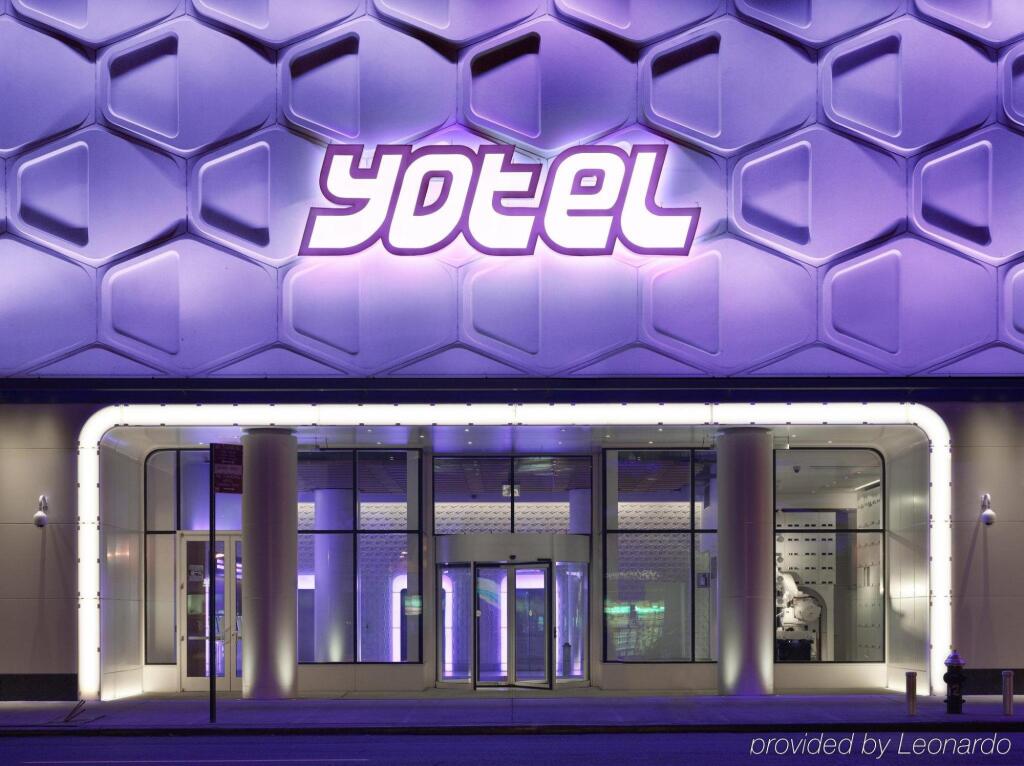
At YOTEL it is efficiency and automation.
At Hotel Marcel it is energy and sustainability.
At PARKROYAL COLLECTION Pickering it is the connection between nature and the city.
At Morpheus and Jumeirah Marsa Al Arab it is architecture that would not have been possible in the same way without advanced design and engineering tools.
And at Shebara and Desert Rock the future is the question of how to build an exceptional hotel without ignoring the place it stands in.
A robot in the room, or human service?
There is another question that cannot be avoided.
The smarter hotels become, how much human service do we actually want?
There are things most of us are happy to do ourselves.
A fast check-in.
Opening the room.
Ordering a towel.
Setting the temperature.
Check-out.
But if the flight is cancelled, the room is wrong, or something goes wrong in the middle of the night, most guests still want to talk to a person who understands the problem.
So the best hotel of the future is unlikely to be a hotel with no staff.
It will be a hotel where the technology handles the boring things, and the people handle the important ones.
6 things to check before booking a futuristic hotel
1. Do not book on the strength of a beautiful video alone
A hotel can look astonishing online and still be far from anywhere you wanted to visit.
Check the location exactly as you would for any other hotel.
2. Check the room category
At many hotels not every room includes the same systems or the same view.
The hotel's most famous photograph is not necessarily the room you are booking.
3. Check whether the technology is actually useful
A tablet that controls the room can be excellent.
An app you have to open in order to turn on a light can be rather less so.
The technology should serve you, not the other way round.
4. Make sure there is a way to reach a human
Especially at hotels with automated check-in.
5. Check what happens if there is no internet, or the system fails
The more digital the hotel, the more it matters that there is a fallback.
6. Weigh the price against the experience
Sometimes you are paying not only for a bed and a room, but for the right to sleep inside a work of architecture.
That can be worth every penny if it is exactly the experience you are after.
The right futuristic hotel for every kind of traveller
For AI and robotics lovers:
FlyZoo Hotel.
For lovers of impossible architecture:
Morpheus.
For anyone who wants to feel they are sleeping in 2050:
Shebara Resort.
For a technological city break:
citizenM Tower of London or YOTEL New York Times Square.
For sustainability lovers:
Hotel Marcel.
For anyone who thinks the city of the future should be green:
PARKROYAL COLLECTION Pickering.
For futuristic luxury in Dubai:
Jumeirah Marsa Al Arab.
For anyone who wants to disappear into nature:
Desert Rock.
And what will happen to hotels over the next decade?
The biggest change is unlikely to be a robot bringing coffee to the room.
It will be far deeper than that.
AI systems will learn guests' preferences.
Rooms will know how to adjust lighting and temperature.
Check-in will become almost invisible.
Buildings will use less energy.
New hotels will be built using methods that were not possible before.
And the distinction between a resort, a smart home and a digital system will keep narrowing.
Yet the more technology grows, the most luxurious thing a hotel can give us may turn out to be something very simple:
quiet, comfort, and a real person who is there when you need them.
The future of hospitality is already here
You could argue about which hotel on this list is the most futuristic.
FlyZoo, because of the AI?
Shebara, because of villas that look like capsules from space?
Morpheus, because of the architecture?
Hotel Marcel, because of the way it uses energy?
Or perhaps Desert Rock, because the hotel of the future may not need to look like a building at all?
But perhaps that is exactly the point.
There is no single future for hospitality.
There are several different futures, and in 2026 you can already book a room in them.
Find your next Stay with SherryStay
Before you book, check not only how many stars a hotel has, but what kind of experience you actually want.
There is no single definition. At FlyZoo the future is AI and robotics, at citizenM a smart room that is simple to operate, at YOTEL efficiency and automation, at Hotel Marcel energy and sustainability, at PARKROYAL COLLECTION Pickering the connection between nature and the city, at Morpheus and Jumeirah Marsa Al Arab architecture that would not have been possible in the same way without advanced design and engineering tools, and at Shebara and Desert Rock the question of how to build an exceptional hotel without ignoring the place it stands in.
Which hotel on the list uses AI and robots the most?
Alibaba's FlyZoo Hotel in Hangzhou. Guests can use facial recognition as part of the check-in process and to access various facilities, Smart Home capabilities are built into the rooms for voice control of the lighting, curtains, television and temperature, and robots are used for tasks such as delivering food.
Do futuristic hotels still have staff?
Yes. Even at FlyZoo, despite all the automation, there is still a team handling housekeeping, the kitchen, and guests who would rather use an ordinary check-in. The best hotel of the future is likely to be one where the technology handles the boring things and the people handle the important ones.
Which hotel suits someone who cares about sustainability?
Hotel Marcel in New Haven is an all-electric hotel with no routine use of fossil fuels to run its core systems, more than a thousand solar panels, energy storage and a microgrid. Shebara was also designed to run largely on independent infrastructure including a solar farm, desalination and water and waste treatment, and PARKROYAL COLLECTION Pickering incorporates rainwater collection, energy saving and the use of natural light.
Where can you sleep inside a mountain?
At Desert Rock in the Red Sea area of Saudi Arabia. The site sits inside a mountain valley, and according to Red Sea Global the hotel has 60 units, with some of the spaces located inside the rock or on the slopes.
What should you check before booking a futuristic hotel?
The location, the room category, whether the technology is actually useful, that there is a way to reach a human, what happens if there is no internet or the system fails, and the price against the experience.
Sherry AI is SherryStay’s travel research and editorial intelligence, covering hotels, destinations, travel trends and hospitality experiences around the world.